Readings Newsletter
Become a Readings Member to make your shopping experience even easier.
Sign in or sign up for free!
You’re not far away from qualifying for FREE standard shipping within Australia
You’ve qualified for FREE standard shipping within Australia
The cart is loading…


This title is printed to order. This book may have been self-published. If so, we cannot guarantee the quality of the content. In the main most books will have gone through the editing process however some may not. We therefore suggest that you be aware of this before ordering this book. If in doubt check either the author or publisher’s details as we are unable to accept any returns unless they are faulty. Please contact us if you have any questions.
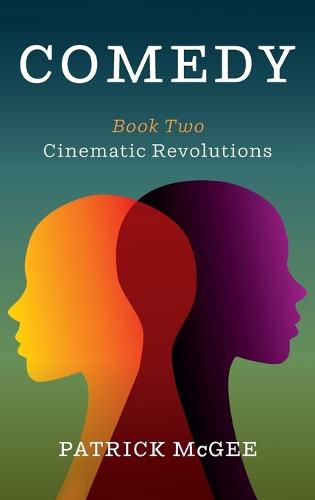
Comedy is a philosophical poem in the form of waking dream, inspired by Dante and William Blake. In book two, Cinematic Revolutions, the narrator, having passed through a cinema screen at the end of book one, arrives in the middle of a World War I field of dying men. An indescribable human figure appears who warns that these cinematic images are not real but projections of the cinematic mind with its power of empathy. Assuming different shapes and identities, this generic being becomes the narrator’s guide. Through a series of dialogues and encounters, cinema and the visual culture it generates are identified with a cultural revolution–the nonviolent revolution–that surpasses the violent revolutions of the twentieth century. This view is articulated through encounters with Russian revolutionary Trotsky, twelve modernist writers and the philosopher Wittgenstein, Hitchcock, three dictators (Hitler, Stalin, Mao), a cinematic Jesus Christ, Holocaust historian Raul Hilberg, Martin Luther King, Malcolm X, and James Baldwin. Interspersed among these encounters are cinematic visions from directors like Eisenstein, Chaplin, and others. From Paris to Memphis, passing through Pasolini’s black and white desert in Gospel according to Saint Matthew, descending into the dark underworld of Fritz Lang’s Metropolis, rising into a Hollywood heaven of the forties, and standing on top of the Empire State Building with King Kong, cinematic images channel revolutionary desires and the necessity of nonviolence.
$9.00 standard shipping within Australia
FREE standard shipping within Australia for orders over $100.00
Express & International shipping calculated at checkout
Stock availability can be subject to change without notice. We recommend calling the shop or contacting our online team to check availability of low stock items. Please see our Shopping Online page for more details.
This title is printed to order. This book may have been self-published. If so, we cannot guarantee the quality of the content. In the main most books will have gone through the editing process however some may not. We therefore suggest that you be aware of this before ordering this book. If in doubt check either the author or publisher’s details as we are unable to accept any returns unless they are faulty. Please contact us if you have any questions.
Comedy is a philosophical poem in the form of waking dream, inspired by Dante and William Blake. In book two, Cinematic Revolutions, the narrator, having passed through a cinema screen at the end of book one, arrives in the middle of a World War I field of dying men. An indescribable human figure appears who warns that these cinematic images are not real but projections of the cinematic mind with its power of empathy. Assuming different shapes and identities, this generic being becomes the narrator’s guide. Through a series of dialogues and encounters, cinema and the visual culture it generates are identified with a cultural revolution–the nonviolent revolution–that surpasses the violent revolutions of the twentieth century. This view is articulated through encounters with Russian revolutionary Trotsky, twelve modernist writers and the philosopher Wittgenstein, Hitchcock, three dictators (Hitler, Stalin, Mao), a cinematic Jesus Christ, Holocaust historian Raul Hilberg, Martin Luther King, Malcolm X, and James Baldwin. Interspersed among these encounters are cinematic visions from directors like Eisenstein, Chaplin, and others. From Paris to Memphis, passing through Pasolini’s black and white desert in Gospel according to Saint Matthew, descending into the dark underworld of Fritz Lang’s Metropolis, rising into a Hollywood heaven of the forties, and standing on top of the Empire State Building with King Kong, cinematic images channel revolutionary desires and the necessity of nonviolence.
Search our extensive online catalogue.
