Readings Newsletter
Become a Readings Member to make your shopping experience even easier.
Sign in or sign up for free!
You’re not far away from qualifying for FREE standard shipping within Australia
You’ve qualified for FREE standard shipping within Australia
The cart is loading…


This title is printed to order. This book may have been self-published. If so, we cannot guarantee the quality of the content. In the main most books will have gone through the editing process however some may not. We therefore suggest that you be aware of this before ordering this book. If in doubt check either the author or publisher’s details as we are unable to accept any returns unless they are faulty. Please contact us if you have any questions.
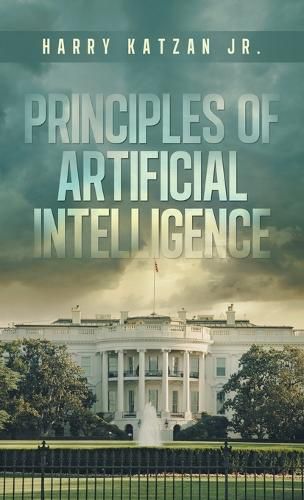
This book covers the Principles of Artifi cial Intelligence. It is both a text book and a reference book. It is one of many books on the subject of artifi cial intelligernce. There are more than 400 of them. It is the only one that covers principles that is intended to refl ect on how to go about doing AI for productive purposes. It also covers about what AI is already, but it is more than that. It answers the question "Can a machine think?" and most people are quite tired of that question. In fact, people are now more interested in how to do what we want to do. In fact, AI is a inportant subject in our lives and here are two outstanding books that atune to that assertion: The Singularity is Nearer (2024) by Ray Kurzweil; Artifi cial Intelligence: A Modern Approach (1995) by Stuart Russell and Peter Norvig; The writers are exceedingly intelligent, and the books are useful but not that easy to read. University research is equally noteworthy. But what about the strategy of adopting AI for the modern operational environment? How do you know what to do and how to do it. Do you have to be a scientist or a mathematician to do the job? Absolutely not. Do you need to be a manager, a major CEO, or even the President of a coiuntry. Probably yes. But you need to have the information to do the job. This book gives you what you should do to implement AI in the organization and precisely what you need to know in order to do it. When doing the job of implementing, should you be knowledgeable about precisly what has to be done? Of course. Do you personally have to do it? Not at all. Do you need information on related subjects, of course again. Do you have to read this book serially? Of course not; it is too detailed. But when you fi nally get it done properly, you do deserve to be a DAI, that is a Doctor of Artifi cial Intelligence. That is proposed to be the case in the future. Will this be happy reading? On some topics, yes. Other sections, not so much. There are a lot of pages because the environment of AI is large and complicated. Many of the subjects covered in this book will be extremely useful in other areas of business and the organizaton. Artifi cial Intelligence is an extremely volatile subject. It is being adjusted daily, and it is almost impossible to fi gure out what is actually going on. The book will be revised and probably copied in content with an air of improvement. That is the way the world operates. Have a useful and interesting time reading the book. It will be worth the effort. One more thing. The book is for fi nding out about AI and associated subjects. Who knowswhat the professional and everyday people want to know. The book is for everyone. Equally important is the fact that the book is specifi cally designed for an online college course on AI and supports that assertion by including a substantional choice of subjects for the online professor. For example, the last section on managing uncertainly is very strongly AI based on the Theory of Evidence through the information on Dempster Shafer Theory. The author has been involved with AI since a university 3-week seminar in 1963 for a large corporation and taught one of the fi rst graduate-level university courses on AI in 1978. He has been the CEO of Artifi cial Intelligence Consulting (AICON), a university professor, and an international AI consultant, after working for Boeing, Oak Ridge National Lab, and IBM. He has written a few books and a few more peer reviewed papers.
$9.00 standard shipping within Australia
FREE standard shipping within Australia for orders over $100.00
Express & International shipping calculated at checkout
Stock availability can be subject to change without notice. We recommend calling the shop or contacting our online team to check availability of low stock items. Please see our Shopping Online page for more details.
This title is printed to order. This book may have been self-published. If so, we cannot guarantee the quality of the content. In the main most books will have gone through the editing process however some may not. We therefore suggest that you be aware of this before ordering this book. If in doubt check either the author or publisher’s details as we are unable to accept any returns unless they are faulty. Please contact us if you have any questions.
This book covers the Principles of Artifi cial Intelligence. It is both a text book and a reference book. It is one of many books on the subject of artifi cial intelligernce. There are more than 400 of them. It is the only one that covers principles that is intended to refl ect on how to go about doing AI for productive purposes. It also covers about what AI is already, but it is more than that. It answers the question "Can a machine think?" and most people are quite tired of that question. In fact, people are now more interested in how to do what we want to do. In fact, AI is a inportant subject in our lives and here are two outstanding books that atune to that assertion: The Singularity is Nearer (2024) by Ray Kurzweil; Artifi cial Intelligence: A Modern Approach (1995) by Stuart Russell and Peter Norvig; The writers are exceedingly intelligent, and the books are useful but not that easy to read. University research is equally noteworthy. But what about the strategy of adopting AI for the modern operational environment? How do you know what to do and how to do it. Do you have to be a scientist or a mathematician to do the job? Absolutely not. Do you need to be a manager, a major CEO, or even the President of a coiuntry. Probably yes. But you need to have the information to do the job. This book gives you what you should do to implement AI in the organization and precisely what you need to know in order to do it. When doing the job of implementing, should you be knowledgeable about precisly what has to be done? Of course. Do you personally have to do it? Not at all. Do you need information on related subjects, of course again. Do you have to read this book serially? Of course not; it is too detailed. But when you fi nally get it done properly, you do deserve to be a DAI, that is a Doctor of Artifi cial Intelligence. That is proposed to be the case in the future. Will this be happy reading? On some topics, yes. Other sections, not so much. There are a lot of pages because the environment of AI is large and complicated. Many of the subjects covered in this book will be extremely useful in other areas of business and the organizaton. Artifi cial Intelligence is an extremely volatile subject. It is being adjusted daily, and it is almost impossible to fi gure out what is actually going on. The book will be revised and probably copied in content with an air of improvement. That is the way the world operates. Have a useful and interesting time reading the book. It will be worth the effort. One more thing. The book is for fi nding out about AI and associated subjects. Who knowswhat the professional and everyday people want to know. The book is for everyone. Equally important is the fact that the book is specifi cally designed for an online college course on AI and supports that assertion by including a substantional choice of subjects for the online professor. For example, the last section on managing uncertainly is very strongly AI based on the Theory of Evidence through the information on Dempster Shafer Theory. The author has been involved with AI since a university 3-week seminar in 1963 for a large corporation and taught one of the fi rst graduate-level university courses on AI in 1978. He has been the CEO of Artifi cial Intelligence Consulting (AICON), a university professor, and an international AI consultant, after working for Boeing, Oak Ridge National Lab, and IBM. He has written a few books and a few more peer reviewed papers.
Search our extensive online catalogue.
