Readings Newsletter
Become a Readings Member to make your shopping experience even easier.
Sign in or sign up for free!
You’re not far away from qualifying for FREE standard shipping within Australia
You’ve qualified for FREE standard shipping within Australia
The cart is loading…


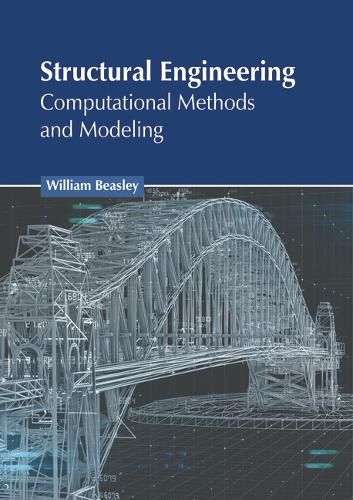
Structural engineering is a branch of civil engineering concerned with designing and analyzing structures to ensure they can withstand loads and forces they may encounter. It applies principles of physics and mathematics to create safe, stable, and durable buildings, bridges, dams, and other infrastructure essential for society's functioning and safety. Computational methods and modeling in structural engineering revolutionize structure analysis and design. These methods make use of advanced software to simulate and predict the behavior of complex systems under various conditions, offering insights into structural performance, safety margins, and potential failure modes. By leveraging mathematical models and algorithms, engineers can optimize designs, reduce material costs, and ensure structures meet stringent safety standards. Moreover, computational methods enable rapid prototyping and iteration, speeding up the design process and facilitating innovation in architectural forms and engineering solutions. This book traces the progress of this field and highlights some of its key concepts and applications. Most of the topics introduced in this book cover new techniques and the applications of computational methods in structural engineering. It aims to serve as a resource guide for students and experts alike and contribute to the growth of the discipline.
$9.00 standard shipping within Australia
FREE standard shipping within Australia for orders over $100.00
Express & International shipping calculated at checkout
Stock availability can be subject to change without notice. We recommend calling the shop or contacting our online team to check availability of low stock items. Please see our Shopping Online page for more details.
Structural engineering is a branch of civil engineering concerned with designing and analyzing structures to ensure they can withstand loads and forces they may encounter. It applies principles of physics and mathematics to create safe, stable, and durable buildings, bridges, dams, and other infrastructure essential for society's functioning and safety. Computational methods and modeling in structural engineering revolutionize structure analysis and design. These methods make use of advanced software to simulate and predict the behavior of complex systems under various conditions, offering insights into structural performance, safety margins, and potential failure modes. By leveraging mathematical models and algorithms, engineers can optimize designs, reduce material costs, and ensure structures meet stringent safety standards. Moreover, computational methods enable rapid prototyping and iteration, speeding up the design process and facilitating innovation in architectural forms and engineering solutions. This book traces the progress of this field and highlights some of its key concepts and applications. Most of the topics introduced in this book cover new techniques and the applications of computational methods in structural engineering. It aims to serve as a resource guide for students and experts alike and contribute to the growth of the discipline.
Search our extensive online catalogue.
