Readings Newsletter
Become a Readings Member to make your shopping experience even easier.
Sign in or sign up for free!
You’re not far away from qualifying for FREE standard shipping within Australia
You’ve qualified for FREE standard shipping within Australia
The cart is loading…


This title is printed to order. This book may have been self-published. If so, we cannot guarantee the quality of the content. In the main most books will have gone through the editing process however some may not. We therefore suggest that you be aware of this before ordering this book. If in doubt check either the author or publisher’s details as we are unable to accept any returns unless they are faulty. Please contact us if you have any questions.
Computing paradigms have continuously evolved to address the growing demands of modern applications. Initially, cloud computing emerged as a transformative approach, enabling the offloading of computationally intensive tasks to centralized and virtualized infrastructures. These infrastructures provide resource scalability and flexibility, and thus can adapt to the diverse applications with varying requirements. However, the centralized nature of cloud computing resources induces additional communication delay and causes network overhead. This is especially problematic for time-sensitive and mission-critical applications. Eventually, edge computing was introduced as a complementary paradigm, bringing computational resources closer to end-users and devices. This proximity benefits time-critical applications by reducing delays and improving responsiveness. It also offers better privacy by processing sensitive data locally on devices or nearby servers, reducing the risk of exposure during transmission to centralized cloud systems. As a natural progression, multi-access edge computing (MEC) has emerged to address the unique requirements of highly dynamic environments.
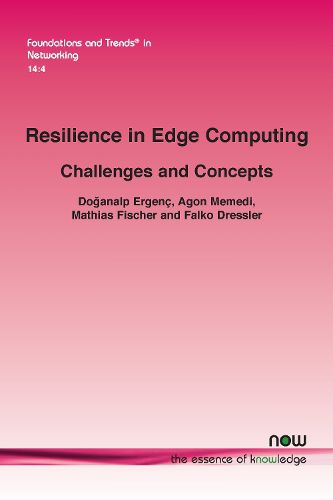
In many 6G-related projects, there is a clear trend toward virtualizing computing resources at the edge. Motivated by the cloud-edge-continuum that is the basis for next-generation metaverse applications and the need for low latency solutions, distributed computing is now receiving even more attention. A final hurdle for the wide use of edge computing for mission-critical applications is resilience. In this context, resilience is the ability of modern communication and computation systems to deal with unknown and unforeseen events, both from internal and external sources. Thus, making MEC resilient to outages, security incidents, and overall challenging conditions is of the highest importance. In this monograph, the current state-of-the-art of resilience in mobile edge computing is reviewed. MEC-specific challenges and resilience objectives are explored, and selected resilience measures are discussed. This monograph is an invaluable resource for beginners and experts in the field and provides a compound resource on resilience in MEC.
$9.00 standard shipping within Australia
FREE standard shipping within Australia for orders over $100.00
Express & International shipping calculated at checkout
Stock availability can be subject to change without notice. We recommend calling the shop or contacting our online team to check availability of low stock items. Please see our Shopping Online page for more details.
This title is printed to order. This book may have been self-published. If so, we cannot guarantee the quality of the content. In the main most books will have gone through the editing process however some may not. We therefore suggest that you be aware of this before ordering this book. If in doubt check either the author or publisher’s details as we are unable to accept any returns unless they are faulty. Please contact us if you have any questions.
Computing paradigms have continuously evolved to address the growing demands of modern applications. Initially, cloud computing emerged as a transformative approach, enabling the offloading of computationally intensive tasks to centralized and virtualized infrastructures. These infrastructures provide resource scalability and flexibility, and thus can adapt to the diverse applications with varying requirements. However, the centralized nature of cloud computing resources induces additional communication delay and causes network overhead. This is especially problematic for time-sensitive and mission-critical applications. Eventually, edge computing was introduced as a complementary paradigm, bringing computational resources closer to end-users and devices. This proximity benefits time-critical applications by reducing delays and improving responsiveness. It also offers better privacy by processing sensitive data locally on devices or nearby servers, reducing the risk of exposure during transmission to centralized cloud systems. As a natural progression, multi-access edge computing (MEC) has emerged to address the unique requirements of highly dynamic environments.
In many 6G-related projects, there is a clear trend toward virtualizing computing resources at the edge. Motivated by the cloud-edge-continuum that is the basis for next-generation metaverse applications and the need for low latency solutions, distributed computing is now receiving even more attention. A final hurdle for the wide use of edge computing for mission-critical applications is resilience. In this context, resilience is the ability of modern communication and computation systems to deal with unknown and unforeseen events, both from internal and external sources. Thus, making MEC resilient to outages, security incidents, and overall challenging conditions is of the highest importance. In this monograph, the current state-of-the-art of resilience in mobile edge computing is reviewed. MEC-specific challenges and resilience objectives are explored, and selected resilience measures are discussed. This monograph is an invaluable resource for beginners and experts in the field and provides a compound resource on resilience in MEC.
Search our extensive online catalogue.
