Readings Newsletter
Become a Readings Member to make your shopping experience even easier.
Sign in or sign up for free!
You’re not far away from qualifying for FREE standard shipping within Australia
You’ve qualified for FREE standard shipping within Australia
The cart is loading…


This title is printed to order. This book may have been self-published. If so, we cannot guarantee the quality of the content. In the main most books will have gone through the editing process however some may not. We therefore suggest that you be aware of this before ordering this book. If in doubt check either the author or publisher’s details as we are unable to accept any returns unless they are faulty. Please contact us if you have any questions.
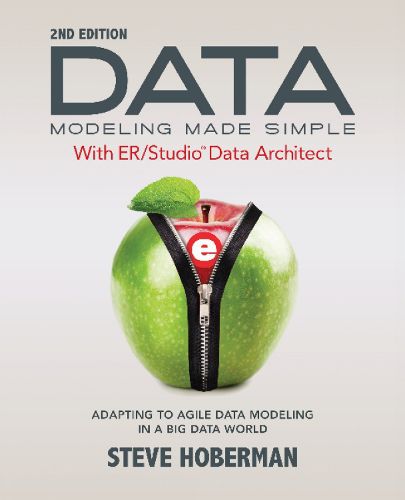
Build a working knowledge of data modeling concepts and best practices, along with how to apply these principles with ER/Studio. This second edition includes numerous updates and new sections including an overview of ER/Studio’s support for agile development, as well as a description of some of ER/Studio’s newer features for NoSQL, such as MongoDB’s containment structure. You will build many ER/Studio data models along the way, applying best practices to master these ten objectives: 1. Know why a data model is needed and which ER/Studio models are the most appropriate for each situation. 2. Understand each component on the data model and how to represent and create them in ER/Studio. 3. Know how to leverage ER/Studio’s latest features including those assisting agile teams and forward and reverse engineering of NoSQL databases. 4. Know how to apply all the foundational features of ER/Studio. 5. Be able to build relational and dimensional conceptual, logical, and physical data models in ER/Studio. 6. Be able to apply techniques such as indexing, transforms, and forward engineering to turn a logical data model into an efficient physical design. 7. Improve data model quality and impact analysis results by leveraging ER/Studio’s lineage functionality and compare/merge utility. 8. Be able to apply ER/Studio’s data dictionary features 9. Learn ways of sharing the data model through reporting and through exporting the model in a variety of formats. 10.Leverage ER/Studio’s naming functionality to improve naming consistency, including the new Automatic Naming Translation feature. This book contains four sections: Section I introduces data modeling and the ER/Studio landscape. Learn why data modeling is so critical to software development and even more importantly, why data modeling is so critical to understanding the business. You will learn about the newest features in ER/Studio (including features on big data and agile), and the ER/Studio environment. By the end of this section, you will have created and saved your first data model in ER/Studio and be ready to start modeling in Section II! Section II explains all of the symbols and text on a data model, including entities, attributes, relationships, domains, and keys. By the time you finish this section, you will be able to read’ a data model of any size or complexity, and create a complete data model in ER/Studio. Section III explores the three different levels of models: conceptual, logical, and physical. A conceptual data model (CDM) represents a business need within a defined scope. The logical data model (LDM) represents a detailed business solution, capturing the business requirements without complicating the model with implementation concerns such as software and hardware. The physical data model (PDM) represents a detailed technical solution. The PDM is the logical data model compromised often to improve performance or usability. The PDM makes up for deficiencies in our technology. By the end of this section you will be able to create conceptual, logical, and physical data models in ER/Studio. Section IV discusses additional features of ER/Studio. These features include data dictionary, data lineage, automating tasks, repository and portal, exporting and reporting, naming standards, and compare and merge functionality.
$9.00 standard shipping within Australia
FREE standard shipping within Australia for orders over $100.00
Express & International shipping calculated at checkout
Stock availability can be subject to change without notice. We recommend calling the shop or contacting our online team to check availability of low stock items. Please see our Shopping Online page for more details.
This title is printed to order. This book may have been self-published. If so, we cannot guarantee the quality of the content. In the main most books will have gone through the editing process however some may not. We therefore suggest that you be aware of this before ordering this book. If in doubt check either the author or publisher’s details as we are unable to accept any returns unless they are faulty. Please contact us if you have any questions.
Build a working knowledge of data modeling concepts and best practices, along with how to apply these principles with ER/Studio. This second edition includes numerous updates and new sections including an overview of ER/Studio’s support for agile development, as well as a description of some of ER/Studio’s newer features for NoSQL, such as MongoDB’s containment structure. You will build many ER/Studio data models along the way, applying best practices to master these ten objectives: 1. Know why a data model is needed and which ER/Studio models are the most appropriate for each situation. 2. Understand each component on the data model and how to represent and create them in ER/Studio. 3. Know how to leverage ER/Studio’s latest features including those assisting agile teams and forward and reverse engineering of NoSQL databases. 4. Know how to apply all the foundational features of ER/Studio. 5. Be able to build relational and dimensional conceptual, logical, and physical data models in ER/Studio. 6. Be able to apply techniques such as indexing, transforms, and forward engineering to turn a logical data model into an efficient physical design. 7. Improve data model quality and impact analysis results by leveraging ER/Studio’s lineage functionality and compare/merge utility. 8. Be able to apply ER/Studio’s data dictionary features 9. Learn ways of sharing the data model through reporting and through exporting the model in a variety of formats. 10.Leverage ER/Studio’s naming functionality to improve naming consistency, including the new Automatic Naming Translation feature. This book contains four sections: Section I introduces data modeling and the ER/Studio landscape. Learn why data modeling is so critical to software development and even more importantly, why data modeling is so critical to understanding the business. You will learn about the newest features in ER/Studio (including features on big data and agile), and the ER/Studio environment. By the end of this section, you will have created and saved your first data model in ER/Studio and be ready to start modeling in Section II! Section II explains all of the symbols and text on a data model, including entities, attributes, relationships, domains, and keys. By the time you finish this section, you will be able to read’ a data model of any size or complexity, and create a complete data model in ER/Studio. Section III explores the three different levels of models: conceptual, logical, and physical. A conceptual data model (CDM) represents a business need within a defined scope. The logical data model (LDM) represents a detailed business solution, capturing the business requirements without complicating the model with implementation concerns such as software and hardware. The physical data model (PDM) represents a detailed technical solution. The PDM is the logical data model compromised often to improve performance or usability. The PDM makes up for deficiencies in our technology. By the end of this section you will be able to create conceptual, logical, and physical data models in ER/Studio. Section IV discusses additional features of ER/Studio. These features include data dictionary, data lineage, automating tasks, repository and portal, exporting and reporting, naming standards, and compare and merge functionality.
Search our extensive online catalogue.
