Readings Newsletter
Become a Readings Member to make your shopping experience even easier.
Sign in or sign up for free!
You’re not far away from qualifying for FREE standard shipping within Australia
You’ve qualified for FREE standard shipping within Australia
The cart is loading…


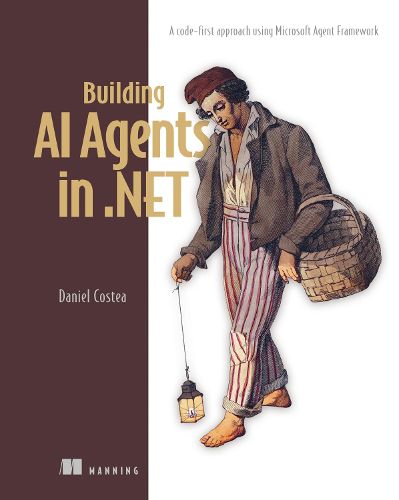
Enterprise apps need copilots, but .NET teams fear steep AI learning curves. Fragmented frameworks and SDK churn make integration plans stall before prototypes launch. Microsoft Agent Framework simplifies orchestration, yet documentation alone leaves critical gaps. This book bridges missing context with practical, production-grade, C# code examples. Build chatbots, copilots, and multimodal agents without rewriting your existing .NET solutions. Deliver intelligent features confidently while maintaining performance, security, and maintainable architecture.
Memory patterns implemented: Maintain short-term context and durable RAG memory for accurate conversations.
Plugin creation and management: Expose, register, and orchestrate tools that extend agent capabilities safely.
Multimodal integration: Combine text, speech, and vision models to enrich user interactions.
Task planners and function calling: Automate multi-step workflows, reducing manual glue code and errors.
Model flexibility: Switch between OpenAI GPT, Llama, or Phi without refactoring business logic.
Enterprise-ready samples: Logging, testing, and security patterns keep agents reliable in production.
Building AI Agents in .NET by Daniel Costea, shares real-world patterns proven across two decades of enterprise projects. Step-by-step projects start small-a chatbot with memory-then scale to a multimodal copilot using planners, plugins, and RAG. Inline diagrams, "what went wrong" callouts, and clean refactors reinforce every concept.
Finish ready to add intelligent agents to greenfield or legacy .NET applications, delighting users while safeguarding performance and budget.
Perfect for beginner-to-expert .NET developers, data scientists, and AI enthusiasts eager to embed generative AI.
$9.00 standard shipping within Australia
FREE standard shipping within Australia for orders over $100.00
Express & International shipping calculated at checkout
Stock availability can be subject to change without notice. We recommend calling the shop or contacting our online team to check availability of low stock items. Please see our Shopping Online page for more details.
Enterprise apps need copilots, but .NET teams fear steep AI learning curves. Fragmented frameworks and SDK churn make integration plans stall before prototypes launch. Microsoft Agent Framework simplifies orchestration, yet documentation alone leaves critical gaps. This book bridges missing context with practical, production-grade, C# code examples. Build chatbots, copilots, and multimodal agents without rewriting your existing .NET solutions. Deliver intelligent features confidently while maintaining performance, security, and maintainable architecture.
Memory patterns implemented: Maintain short-term context and durable RAG memory for accurate conversations.
Plugin creation and management: Expose, register, and orchestrate tools that extend agent capabilities safely.
Multimodal integration: Combine text, speech, and vision models to enrich user interactions.
Task planners and function calling: Automate multi-step workflows, reducing manual glue code and errors.
Model flexibility: Switch between OpenAI GPT, Llama, or Phi without refactoring business logic.
Enterprise-ready samples: Logging, testing, and security patterns keep agents reliable in production.
Building AI Agents in .NET by Daniel Costea, shares real-world patterns proven across two decades of enterprise projects. Step-by-step projects start small-a chatbot with memory-then scale to a multimodal copilot using planners, plugins, and RAG. Inline diagrams, "what went wrong" callouts, and clean refactors reinforce every concept.
Finish ready to add intelligent agents to greenfield or legacy .NET applications, delighting users while safeguarding performance and budget.
Perfect for beginner-to-expert .NET developers, data scientists, and AI enthusiasts eager to embed generative AI.
Search our extensive online catalogue.
