Readings Newsletter
Become a Readings Member to make your shopping experience even easier.
Sign in or sign up for free!
You’re not far away from qualifying for FREE standard shipping within Australia
You’ve qualified for FREE standard shipping within Australia
The cart is loading…


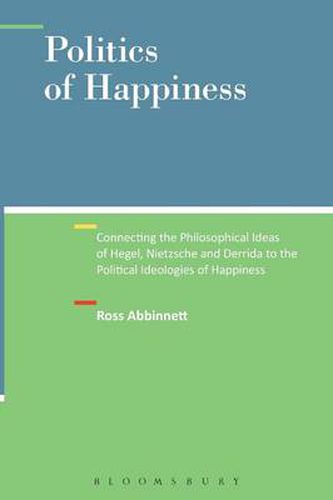
This unique and engaging study argues that the Western concern with achieving happiness should be understood in terms of its relationship to the political ideologies that have emerged since the Enlightenment. To do so, each chapter examines the place that happiness occupies in the construction of ideologies that have formed the political terrain of the West, including liberalism, postmodernism, socialism, fascism, and religion. Throughout, Hegel’s phenomenology, Nietzsche’s genealogy, and Derrida’s account of deconstruction as reactions to modernization are used to show that the politics of happiness are always a clash of fundamental ideas of belonging, overcoming, and ethical responsibility. Stressing that the concept of happiness lies at the foundation of political movements, the book also looks at its place in the current global order, analyzing the emergence of such ideas as affective democracy that challenge the conventional notions of privatized, acquisitive happiness.
Written in a clear manner, the work will appeal to political theory students and researchers looking for a critical and historical account of contemporary debates about the nature of happiness and ideology.
$9.00 standard shipping within Australia
FREE standard shipping within Australia for orders over $100.00
Express & International shipping calculated at checkout
Stock availability can be subject to change without notice. We recommend calling the shop or contacting our online team to check availability of low stock items. Please see our Shopping Online page for more details.
This unique and engaging study argues that the Western concern with achieving happiness should be understood in terms of its relationship to the political ideologies that have emerged since the Enlightenment. To do so, each chapter examines the place that happiness occupies in the construction of ideologies that have formed the political terrain of the West, including liberalism, postmodernism, socialism, fascism, and religion. Throughout, Hegel’s phenomenology, Nietzsche’s genealogy, and Derrida’s account of deconstruction as reactions to modernization are used to show that the politics of happiness are always a clash of fundamental ideas of belonging, overcoming, and ethical responsibility. Stressing that the concept of happiness lies at the foundation of political movements, the book also looks at its place in the current global order, analyzing the emergence of such ideas as affective democracy that challenge the conventional notions of privatized, acquisitive happiness.
Written in a clear manner, the work will appeal to political theory students and researchers looking for a critical and historical account of contemporary debates about the nature of happiness and ideology.
Search our extensive online catalogue.
