Readings Newsletter
Become a Readings Member to make your shopping experience even easier.
Sign in or sign up for free!
You’re not far away from qualifying for FREE standard shipping within Australia
You’ve qualified for FREE standard shipping within Australia
The cart is loading…


This title is printed to order. This book may have been self-published. If so, we cannot guarantee the quality of the content. In the main most books will have gone through the editing process however some may not. We therefore suggest that you be aware of this before ordering this book. If in doubt check either the author or publisher’s details as we are unable to accept any returns unless they are faulty. Please contact us if you have any questions.
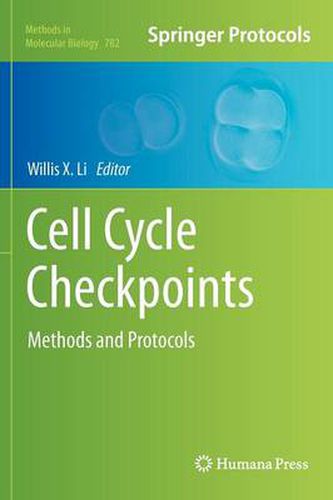
Cell cycle checkpoints control the fidelity and orderly progression of eukaryotic cell division. By controlling the orderly progression of critical cell cycle events such as DNA replication and chromosome segregation and ensuring proper repair of damaged DNA, cell cycle checkpoints function to ensure genome integrity. Mechanisms of checkpoint controls are not only the research focus of investigators interested in mechanisms that regulate the cell cycle, but are also the interests of researchers studying cancer development as it is increasingly clear that loss of cell cycle checkpoints, which leads to genomic instability as a result, is a hallmark of tumorigenesis. Cell Cycle Checkpoints: Methods and Protocols provides detailed descriptions of methodologies currently employed by researchers in the field, including those commonly used in the mammalian, yeast, C. elegans, Drosophila, and Xenopus model systems. Each chapter describes a specific technique or protocol, such as a method to induce cell cycle checkpoints in a particular model system, to synchronize a population of cells to allow observations of cell cycle progression, to identify genes involved in checkpoint regulation, and to study particular protein components of cell cycle checkpoint pathways. Written in the highly successful Methods in Molecular Biology ™ series format, chapters contain introductions to their respective topics, lists of the necessary materials and reagents, step-by-step, readily reproducible laboratory protocols, and notes on troubleshooting and avoiding known pitfalls.
Authoritative and easily accessible, Cell Cycle Checkpoints: Methods and Protocols seeks to serve both professionals and novices with its well-honed methodologies in an effort to further our knowledge of this essential field.
$9.00 standard shipping within Australia
FREE standard shipping within Australia for orders over $100.00
Express & International shipping calculated at checkout
Stock availability can be subject to change without notice. We recommend calling the shop or contacting our online team to check availability of low stock items. Please see our Shopping Online page for more details.
This title is printed to order. This book may have been self-published. If so, we cannot guarantee the quality of the content. In the main most books will have gone through the editing process however some may not. We therefore suggest that you be aware of this before ordering this book. If in doubt check either the author or publisher’s details as we are unable to accept any returns unless they are faulty. Please contact us if you have any questions.
Cell cycle checkpoints control the fidelity and orderly progression of eukaryotic cell division. By controlling the orderly progression of critical cell cycle events such as DNA replication and chromosome segregation and ensuring proper repair of damaged DNA, cell cycle checkpoints function to ensure genome integrity. Mechanisms of checkpoint controls are not only the research focus of investigators interested in mechanisms that regulate the cell cycle, but are also the interests of researchers studying cancer development as it is increasingly clear that loss of cell cycle checkpoints, which leads to genomic instability as a result, is a hallmark of tumorigenesis. Cell Cycle Checkpoints: Methods and Protocols provides detailed descriptions of methodologies currently employed by researchers in the field, including those commonly used in the mammalian, yeast, C. elegans, Drosophila, and Xenopus model systems. Each chapter describes a specific technique or protocol, such as a method to induce cell cycle checkpoints in a particular model system, to synchronize a population of cells to allow observations of cell cycle progression, to identify genes involved in checkpoint regulation, and to study particular protein components of cell cycle checkpoint pathways. Written in the highly successful Methods in Molecular Biology ™ series format, chapters contain introductions to their respective topics, lists of the necessary materials and reagents, step-by-step, readily reproducible laboratory protocols, and notes on troubleshooting and avoiding known pitfalls.
Authoritative and easily accessible, Cell Cycle Checkpoints: Methods and Protocols seeks to serve both professionals and novices with its well-honed methodologies in an effort to further our knowledge of this essential field.
Search our extensive online catalogue.
