Readings Newsletter
Become a Readings Member to make your shopping experience even easier.
Sign in or sign up for free!
You’re not far away from qualifying for FREE standard shipping within Australia
You’ve qualified for FREE standard shipping within Australia
The cart is loading…


This title is printed to order. This book may have been self-published. If so, we cannot guarantee the quality of the content. In the main most books will have gone through the editing process however some may not. We therefore suggest that you be aware of this before ordering this book. If in doubt check either the author or publisher’s details as we are unable to accept any returns unless they are faulty. Please contact us if you have any questions.
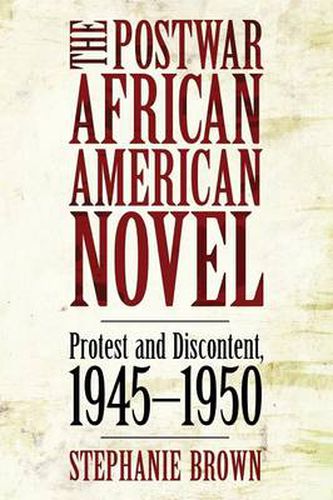
Americans in the World War II era bought the novels of African American writers in unprecedented numbers. But the names on the books lining shelves and filling barracks trunks were not the now-familiar Richard Wright and Ralph Ellison, but Frank Yerby, Chester Himes, William Gardner Smith, and J. Saunders Redding.
In this book, Stephanie Brown recovers the work of these innovative novelists, overturning conventional wisdom about the writers of the period and the trajectory of African American literary history. She also questions the assumptions about the relations between race and genre that have obscured the importance of these once-influential creators.
Wright’s Native Son (1940) is typically considered to have inaugurated an era of social realism in African American literature. And Ellison’s Invisible Man (1952) has been cast as both a high mark of American modernism and the only worthy stopover on the way to the Black Arts Movement of the 1960s. But readers in the late 1940s purchased enough copies of Yerby’s historical romances to make him the best-selling African American author of all time. Critics, meanwhile, were taking note of the generic experiments of Redding, Himes, and Smith, while the authors themselves questioned the obligation of black authors to write protest, instead penning campus novels, war novels, and, in Yerby’s case,
costume dramas.
Their status as
lesser lights
is the product of retrospective bias, Brown demonstrates, and their novels established the period immediately following World War II as a pivotal moment in the history of the African American novel.
$9.00 standard shipping within Australia
FREE standard shipping within Australia for orders over $100.00
Express & International shipping calculated at checkout
Stock availability can be subject to change without notice. We recommend calling the shop or contacting our online team to check availability of low stock items. Please see our Shopping Online page for more details.
This title is printed to order. This book may have been self-published. If so, we cannot guarantee the quality of the content. In the main most books will have gone through the editing process however some may not. We therefore suggest that you be aware of this before ordering this book. If in doubt check either the author or publisher’s details as we are unable to accept any returns unless they are faulty. Please contact us if you have any questions.
Americans in the World War II era bought the novels of African American writers in unprecedented numbers. But the names on the books lining shelves and filling barracks trunks were not the now-familiar Richard Wright and Ralph Ellison, but Frank Yerby, Chester Himes, William Gardner Smith, and J. Saunders Redding.
In this book, Stephanie Brown recovers the work of these innovative novelists, overturning conventional wisdom about the writers of the period and the trajectory of African American literary history. She also questions the assumptions about the relations between race and genre that have obscured the importance of these once-influential creators.
Wright’s Native Son (1940) is typically considered to have inaugurated an era of social realism in African American literature. And Ellison’s Invisible Man (1952) has been cast as both a high mark of American modernism and the only worthy stopover on the way to the Black Arts Movement of the 1960s. But readers in the late 1940s purchased enough copies of Yerby’s historical romances to make him the best-selling African American author of all time. Critics, meanwhile, were taking note of the generic experiments of Redding, Himes, and Smith, while the authors themselves questioned the obligation of black authors to write protest, instead penning campus novels, war novels, and, in Yerby’s case,
costume dramas.
Their status as
lesser lights
is the product of retrospective bias, Brown demonstrates, and their novels established the period immediately following World War II as a pivotal moment in the history of the African American novel.
Search our extensive online catalogue.
