Readings Newsletter
Become a Readings Member to make your shopping experience even easier.
Sign in or sign up for free!
You’re not far away from qualifying for FREE standard shipping within Australia
You’ve qualified for FREE standard shipping within Australia
The cart is loading…


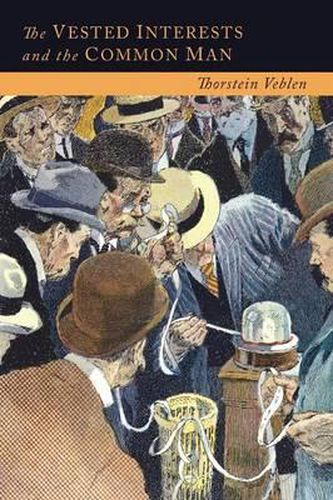
2014 Reprint of 1946 Edition. Full facsimile of the original edition, not reproduced with Optical Recognition Software. Many of the essays in this collection originally appeared in Dial from October 1918 to January 1919. The Vested Interest includes: The Instability of Knowledge and Belief,
The Stability of Law and Custom,
The State of the Industrial Arts,
Free Income,
The Vested Interests,
The Divine Rights of Nations,
Live and Let Live, and The Vested Interests and the Common Man. Veblen saw an inherent conflict between financial interests and industrial interests. Veblen’s two-class model of social stratification includes a financial class, which owns wealth invested in large holdings, and an industrial class, whose conditions of life are controlled by others and who live by work. On the one hand, financial leaders are almost exclusively concerned with financial matters-especially profit-and make no contribution to production. Veblen sees these captains of industry as parasitic and exploitative. On the other hand, industry is oriented toward workmanship and production. Unlike the pecuniary financial orientation, the industrial orientation is an impersonal standpoint of quantitative relations and mechanical efficiency. According to Veblen, financial leaders obstruct the operation of the industrial system. Veblen argued that an advanced industrial society would be run most efficiently by production engineers who would look out for the welfare of all members of society rather than the vested interests of business.
$9.00 standard shipping within Australia
FREE standard shipping within Australia for orders over $100.00
Express & International shipping calculated at checkout
Stock availability can be subject to change without notice. We recommend calling the shop or contacting our online team to check availability of low stock items. Please see our Shopping Online page for more details.
2014 Reprint of 1946 Edition. Full facsimile of the original edition, not reproduced with Optical Recognition Software. Many of the essays in this collection originally appeared in Dial from October 1918 to January 1919. The Vested Interest includes: The Instability of Knowledge and Belief,
The Stability of Law and Custom,
The State of the Industrial Arts,
Free Income,
The Vested Interests,
The Divine Rights of Nations,
Live and Let Live, and The Vested Interests and the Common Man. Veblen saw an inherent conflict between financial interests and industrial interests. Veblen’s two-class model of social stratification includes a financial class, which owns wealth invested in large holdings, and an industrial class, whose conditions of life are controlled by others and who live by work. On the one hand, financial leaders are almost exclusively concerned with financial matters-especially profit-and make no contribution to production. Veblen sees these captains of industry as parasitic and exploitative. On the other hand, industry is oriented toward workmanship and production. Unlike the pecuniary financial orientation, the industrial orientation is an impersonal standpoint of quantitative relations and mechanical efficiency. According to Veblen, financial leaders obstruct the operation of the industrial system. Veblen argued that an advanced industrial society would be run most efficiently by production engineers who would look out for the welfare of all members of society rather than the vested interests of business.
Search our extensive online catalogue.
