Readings Newsletter
Become a Readings Member to make your shopping experience even easier.
Sign in or sign up for free!
You’re not far away from qualifying for FREE standard shipping within Australia
You’ve qualified for FREE standard shipping within Australia
The cart is loading…


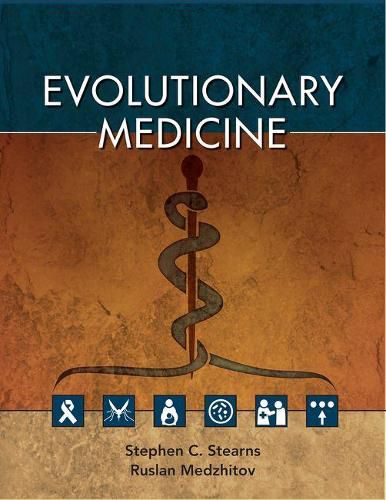
Evolutionary Medicine is a textbook intended for use in undergraduate, graduate, medical school, and continuing medical education (CME) courses. Its professional illustrations and summaries of chapters and sections make its messages readily accessible.Chapter 1 introduces evolutionary thinking about both current dynamic processes and the deep patterns of history and relationship.Chapter 2 asks, What is a patient? and answers from a series of perspectives.Chapter 3 asks, What is a disease? Some causes are found in patients; others in pathogens; many in the interactions between them.Chapter 4 discusses the nature of defenses, the strategies that determine how they are deployed, and their costs as well as their benefits.Chapter 5 discusses pathogen evolution: the evolution of intrinsic virulence, of evasion and manipulation of host defenses, and of resistance to treatment, and how therapy might be made evolution-proof.Chapter 6 describes cancer as an evolutionary process with a history traced in the genome and with major implications for treatment.Chapter 7 discusses conflicts in reproduction: between mother and offspring, between maternally and paternally derived genes in the offspring, and among siblings. It also discusses menstruation, menopause, and the connection between invasive placentas and metastatic cancer.Chapter 8 discusses mismatches to modern environments, including obesity, cardiovascular disease, and autoimmune diseases.Chapter 9 discusses evolutionary perspectives on addiction, anxiety, depression, obsessive-compulsive disorder, autism, and schizophrenia.Chapter 10 explores the tension between individual and group interests and shows how medicine is creating new problems while solving old ones.Chapter 11 starts with questions that have not yet been answered, discusses why we have not chosen to address some issues, and concludes by comparing classical with evolutionary medicine.RESOURCESInstructor’s Resource LibraryAvailable to qualified adopters, the Instructor’s Resource Library includes the following resources:*Textbook Figures & Tables: All figures (line-art illustrations and photographs) and tables from the textbook, provided as both high- and low-resolution JPEGs. All have been formatted and optimized for excellent projection quality. Also included are ready-to-use PowerPoint presentations of all figures and tables.*Lecture Presentations: For each chapter of the textbook, the authors have prepared ready-to-use lecture presentations that include text reviewing the key facts and concepts from the chapter, along with selected figures and tables.
$9.00 standard shipping within Australia
FREE standard shipping within Australia for orders over $100.00
Express & International shipping calculated at checkout
Stock availability can be subject to change without notice. We recommend calling the shop or contacting our online team to check availability of low stock items. Please see our Shopping Online page for more details.
Evolutionary Medicine is a textbook intended for use in undergraduate, graduate, medical school, and continuing medical education (CME) courses. Its professional illustrations and summaries of chapters and sections make its messages readily accessible.Chapter 1 introduces evolutionary thinking about both current dynamic processes and the deep patterns of history and relationship.Chapter 2 asks, What is a patient? and answers from a series of perspectives.Chapter 3 asks, What is a disease? Some causes are found in patients; others in pathogens; many in the interactions between them.Chapter 4 discusses the nature of defenses, the strategies that determine how they are deployed, and their costs as well as their benefits.Chapter 5 discusses pathogen evolution: the evolution of intrinsic virulence, of evasion and manipulation of host defenses, and of resistance to treatment, and how therapy might be made evolution-proof.Chapter 6 describes cancer as an evolutionary process with a history traced in the genome and with major implications for treatment.Chapter 7 discusses conflicts in reproduction: between mother and offspring, between maternally and paternally derived genes in the offspring, and among siblings. It also discusses menstruation, menopause, and the connection between invasive placentas and metastatic cancer.Chapter 8 discusses mismatches to modern environments, including obesity, cardiovascular disease, and autoimmune diseases.Chapter 9 discusses evolutionary perspectives on addiction, anxiety, depression, obsessive-compulsive disorder, autism, and schizophrenia.Chapter 10 explores the tension between individual and group interests and shows how medicine is creating new problems while solving old ones.Chapter 11 starts with questions that have not yet been answered, discusses why we have not chosen to address some issues, and concludes by comparing classical with evolutionary medicine.RESOURCESInstructor’s Resource LibraryAvailable to qualified adopters, the Instructor’s Resource Library includes the following resources:*Textbook Figures & Tables: All figures (line-art illustrations and photographs) and tables from the textbook, provided as both high- and low-resolution JPEGs. All have been formatted and optimized for excellent projection quality. Also included are ready-to-use PowerPoint presentations of all figures and tables.*Lecture Presentations: For each chapter of the textbook, the authors have prepared ready-to-use lecture presentations that include text reviewing the key facts and concepts from the chapter, along with selected figures and tables.
Search our extensive online catalogue.
