Readings Newsletter
Become a Readings Member to make your shopping experience even easier.
Sign in or sign up for free!
You’re not far away from qualifying for FREE standard shipping within Australia
You’ve qualified for FREE standard shipping within Australia
The cart is loading…


This title is printed to order. This book may have been self-published. If so, we cannot guarantee the quality of the content. In the main most books will have gone through the editing process however some may not. We therefore suggest that you be aware of this before ordering this book. If in doubt check either the author or publisher’s details as we are unable to accept any returns unless they are faulty. Please contact us if you have any questions.
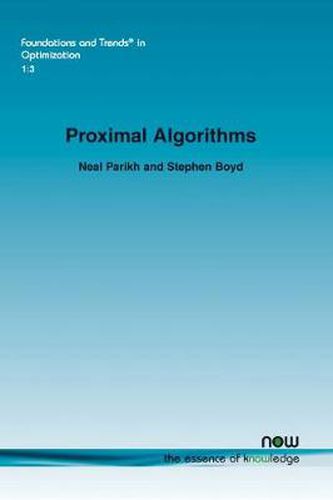
Proximal Algorithms discusses proximal operators and proximal algorithms, and illustrates their applicability to standard and distributed convex optimization in general and many applications of recent interest in particular. Much like Newton’s method is a standard tool for solving unconstrained smooth optimization problems of modest size, proximal algorithms can be viewed as an analogous tool for nonsmooth, constrained, large-scale, or distributed versions of these problems. They are very generally applicable, but are especially well-suited to problems of substantial recent interest involving large or high-dimensional datasets.
Proximal methods sit at a higher level of abstraction than classical algorithms like Newton’s method: the base operation is evaluating the proximal operator of a function, which itself involves solving a small convex optimization problem. These subproblems, which generalize the problem of projecting a point onto a convex set, often admit closed-form solutions or can be solved very quickly with standard or simple specialized methods.
Proximal Algorithms discusses different interpretations of proximal operators and algorithms, looks at their connections to many other topics in optimization and applied mathematics, surveys some popular algorithms, and provides a large number of examples of proximal operators that commonly arise in practice.
$9.00 standard shipping within Australia
FREE standard shipping within Australia for orders over $100.00
Express & International shipping calculated at checkout
Stock availability can be subject to change without notice. We recommend calling the shop or contacting our online team to check availability of low stock items. Please see our Shopping Online page for more details.
This title is printed to order. This book may have been self-published. If so, we cannot guarantee the quality of the content. In the main most books will have gone through the editing process however some may not. We therefore suggest that you be aware of this before ordering this book. If in doubt check either the author or publisher’s details as we are unable to accept any returns unless they are faulty. Please contact us if you have any questions.
Proximal Algorithms discusses proximal operators and proximal algorithms, and illustrates their applicability to standard and distributed convex optimization in general and many applications of recent interest in particular. Much like Newton’s method is a standard tool for solving unconstrained smooth optimization problems of modest size, proximal algorithms can be viewed as an analogous tool for nonsmooth, constrained, large-scale, or distributed versions of these problems. They are very generally applicable, but are especially well-suited to problems of substantial recent interest involving large or high-dimensional datasets.
Proximal methods sit at a higher level of abstraction than classical algorithms like Newton’s method: the base operation is evaluating the proximal operator of a function, which itself involves solving a small convex optimization problem. These subproblems, which generalize the problem of projecting a point onto a convex set, often admit closed-form solutions or can be solved very quickly with standard or simple specialized methods.
Proximal Algorithms discusses different interpretations of proximal operators and algorithms, looks at their connections to many other topics in optimization and applied mathematics, surveys some popular algorithms, and provides a large number of examples of proximal operators that commonly arise in practice.
Search our extensive online catalogue.
