Readings Newsletter
Become a Readings Member to make your shopping experience even easier.
Sign in or sign up for free!
You’re not far away from qualifying for FREE standard shipping within Australia
You’ve qualified for FREE standard shipping within Australia
The cart is loading…


This title is printed to order. This book may have been self-published. If so, we cannot guarantee the quality of the content. In the main most books will have gone through the editing process however some may not. We therefore suggest that you be aware of this before ordering this book. If in doubt check either the author or publisher’s details as we are unable to accept any returns unless they are faulty. Please contact us if you have any questions.
In this Hebrew language learning setting, students’ backgrounds and histories are diverse: some were born and raised in Canada, the United States, or South Africa and studied Hebrew at Jewish day schools; others were born in the former USSR, immigrated to Israel as children, and moved to Canada with their families as teenagers; others were children of Israeli emigrants who learned Hebrew at home. This ethnographic qualitative study examines two conflicting camps within the Hebrew class, defined by themselves and Othered by opposing sub-groups as
Canadians
and
Israelis . As the students and the author negotiate their strong ties to the language with Othering and exclusion by other sub-groups from the dominant speech community, the sentiment of the Israeli emigrant professor regarding her students hangs overhead:
None of them are Israelis. None of them are native speakers of Hebrew.
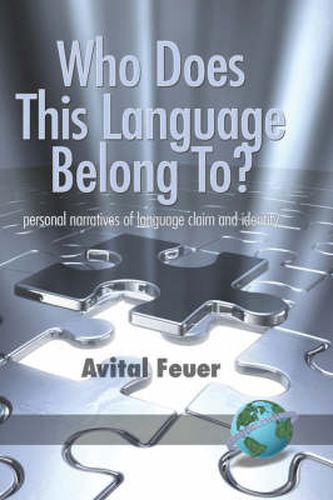
Who does this language belong to? Which subgroup can declare authenticity as real, rightful owners of the language and its indelible culture and identity?As language programs worldwide deal with a diverse and heterogeneous student population who enter the classroom categorized as heritage, second, bilingual, foreign, or native language speakers, this book addresses clashing and Othering between sub-groups over the authenticity of the variety of the language and its speakers, and who can rightfully claim the language as their own.
$9.00 standard shipping within Australia
FREE standard shipping within Australia for orders over $100.00
Express & International shipping calculated at checkout
Stock availability can be subject to change without notice. We recommend calling the shop or contacting our online team to check availability of low stock items. Please see our Shopping Online page for more details.
This title is printed to order. This book may have been self-published. If so, we cannot guarantee the quality of the content. In the main most books will have gone through the editing process however some may not. We therefore suggest that you be aware of this before ordering this book. If in doubt check either the author or publisher’s details as we are unable to accept any returns unless they are faulty. Please contact us if you have any questions.
In this Hebrew language learning setting, students’ backgrounds and histories are diverse: some were born and raised in Canada, the United States, or South Africa and studied Hebrew at Jewish day schools; others were born in the former USSR, immigrated to Israel as children, and moved to Canada with their families as teenagers; others were children of Israeli emigrants who learned Hebrew at home. This ethnographic qualitative study examines two conflicting camps within the Hebrew class, defined by themselves and Othered by opposing sub-groups as
Canadians
and
Israelis . As the students and the author negotiate their strong ties to the language with Othering and exclusion by other sub-groups from the dominant speech community, the sentiment of the Israeli emigrant professor regarding her students hangs overhead:
None of them are Israelis. None of them are native speakers of Hebrew.
Who does this language belong to? Which subgroup can declare authenticity as real, rightful owners of the language and its indelible culture and identity?As language programs worldwide deal with a diverse and heterogeneous student population who enter the classroom categorized as heritage, second, bilingual, foreign, or native language speakers, this book addresses clashing and Othering between sub-groups over the authenticity of the variety of the language and its speakers, and who can rightfully claim the language as their own.
Search our extensive online catalogue.
