Readings Newsletter
Become a Readings Member to make your shopping experience even easier.
Sign in or sign up for free!
You’re not far away from qualifying for FREE standard shipping within Australia
You’ve qualified for FREE standard shipping within Australia
The cart is loading…


This title is printed to order. This book may have been self-published. If so, we cannot guarantee the quality of the content. In the main most books will have gone through the editing process however some may not. We therefore suggest that you be aware of this before ordering this book. If in doubt check either the author or publisher’s details as we are unable to accept any returns unless they are faulty. Please contact us if you have any questions.
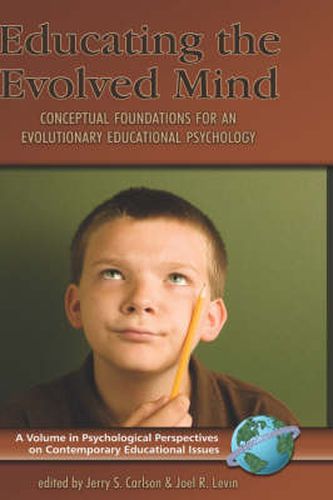
In this volume, David Geary provides a comprehensive theory that brings children’s education into the 21st century, and provides directions for the development of a new discipline, evolutionary educational psychology. Geary presents the case that a scientifically grounded approach to children’s schooling and, to a lesser degree, their later occupational interests can be informed by recent advances in the application of evolutionary theory to the understanding of the human brain, mind, and its development. He develops a taxonomy of evolved cognitive abilities and describes how, from an evolutionary perspective, these abilities are modified and refined during childhood. From there, he lays the framework for understanding the relation between evolved abilities, such as language, and the non-evolved competencies that are built from them with schooling, such as reading. Geary describes the mechanisms, such as working memory, that enable humans to transform evolved cognitive abilities into culturally important, school taught competencies.These are integrated with discussion of human intellectual history and cultural evolution, and the sources of children’s motivation to learn inside and outside of the classroom. In all, this may well be the most revolutionary theory of children’s schooling since Rousseau.
$9.00 standard shipping within Australia
FREE standard shipping within Australia for orders over $100.00
Express & International shipping calculated at checkout
Stock availability can be subject to change without notice. We recommend calling the shop or contacting our online team to check availability of low stock items. Please see our Shopping Online page for more details.
This title is printed to order. This book may have been self-published. If so, we cannot guarantee the quality of the content. In the main most books will have gone through the editing process however some may not. We therefore suggest that you be aware of this before ordering this book. If in doubt check either the author or publisher’s details as we are unable to accept any returns unless they are faulty. Please contact us if you have any questions.
In this volume, David Geary provides a comprehensive theory that brings children’s education into the 21st century, and provides directions for the development of a new discipline, evolutionary educational psychology. Geary presents the case that a scientifically grounded approach to children’s schooling and, to a lesser degree, their later occupational interests can be informed by recent advances in the application of evolutionary theory to the understanding of the human brain, mind, and its development. He develops a taxonomy of evolved cognitive abilities and describes how, from an evolutionary perspective, these abilities are modified and refined during childhood. From there, he lays the framework for understanding the relation between evolved abilities, such as language, and the non-evolved competencies that are built from them with schooling, such as reading. Geary describes the mechanisms, such as working memory, that enable humans to transform evolved cognitive abilities into culturally important, school taught competencies.These are integrated with discussion of human intellectual history and cultural evolution, and the sources of children’s motivation to learn inside and outside of the classroom. In all, this may well be the most revolutionary theory of children’s schooling since Rousseau.
Search our extensive online catalogue.
