Readings Newsletter
Become a Readings Member to make your shopping experience even easier.
Sign in or sign up for free!
You’re not far away from qualifying for FREE standard shipping within Australia
You’ve qualified for FREE standard shipping within Australia
The cart is loading…


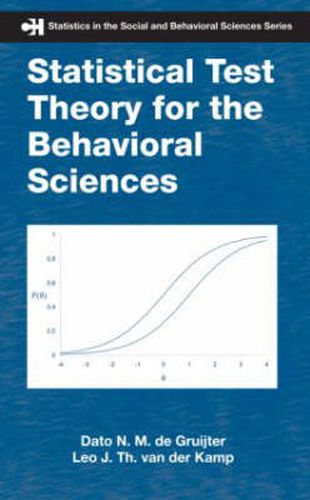
Since the development of the first intelligence test in the early 20th century, educational and psychological tests have become important measurement techniques to quantify human behavior. Focusing on this ubiquitous yet fruitful area of research, Statistical Test Theoryfor the Behavioral Sciences provides both a broad overview and a critical survey of assorted testing theories and models used in psychology, education, and other behavioral science fields.
Following a logical progression from basic concepts to more advanced topics, the book first explains classical test theory, covering true score, measurement error, and reliability. It then presents generalizability theory, which provides a framework to deal with various aspects of test scores. In addition, the authors discuss the concept of validity in testing, offering a strategy for evidence-based validity. In the two chapters devoted to item response theory (IRT), the book explores item response models, such as the Rasch model, and applications, including computerized adaptive testing (CAT). The last chapter looks at some methods used to equate tests.
Equipped with the essential material found in this book, advanced undergraduate and graduate students in the behavioral sciences as well as researchers involved in measurement and testing will gain valuable insight into the research methodologies and statistical data analyses of behavioral testing.
$9.00 standard shipping within Australia
FREE standard shipping within Australia for orders over $100.00
Express & International shipping calculated at checkout
Stock availability can be subject to change without notice. We recommend calling the shop or contacting our online team to check availability of low stock items. Please see our Shopping Online page for more details.
Since the development of the first intelligence test in the early 20th century, educational and psychological tests have become important measurement techniques to quantify human behavior. Focusing on this ubiquitous yet fruitful area of research, Statistical Test Theoryfor the Behavioral Sciences provides both a broad overview and a critical survey of assorted testing theories and models used in psychology, education, and other behavioral science fields.
Following a logical progression from basic concepts to more advanced topics, the book first explains classical test theory, covering true score, measurement error, and reliability. It then presents generalizability theory, which provides a framework to deal with various aspects of test scores. In addition, the authors discuss the concept of validity in testing, offering a strategy for evidence-based validity. In the two chapters devoted to item response theory (IRT), the book explores item response models, such as the Rasch model, and applications, including computerized adaptive testing (CAT). The last chapter looks at some methods used to equate tests.
Equipped with the essential material found in this book, advanced undergraduate and graduate students in the behavioral sciences as well as researchers involved in measurement and testing will gain valuable insight into the research methodologies and statistical data analyses of behavioral testing.
Search our extensive online catalogue.
