Readings Newsletter
Become a Readings Member to make your shopping experience even easier.
Sign in or sign up for free!
You’re not far away from qualifying for FREE standard shipping within Australia
You’ve qualified for FREE standard shipping within Australia
The cart is loading…


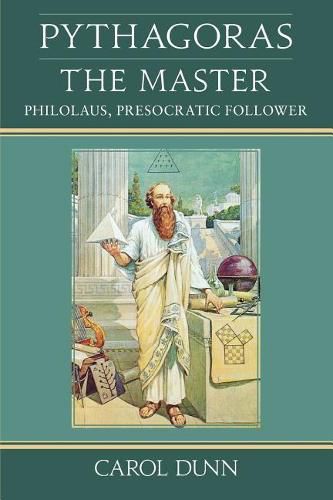
Pythagoras was one of the great geniuses of the West and yet, apart from his famous Pythagorean theorem, he is virtually unknown. If we rely on modern scholars and academics, argues Carol Dunn, we find that his long-forgotten legacy is misunderstood and even distorted, and is therefore almost nonexistent.
First, it shows that the early pioneers of modern physics, mainly Newton and Kepler, scientifically and mathematically confirmed Pythagoras’ discoveries of the sixth century BC – the heliocentric theory of our cosmos and the parallel theory regarding the Harmony of the Spheres. These are discoveries for which Pythagoras has received scant recognition by the Western philosophical tradition.
Second, the author argues against the proposition that the heliocentric theory was initiated not by Pythagoras but instead by his student Philolaus, who lived in the fifth century BC, and whose astronomical theory, according to Dunn, is not based on science.
Pythagoras, the Master is well researched and accessible, offering readers a firm basis to reexamine the importance of Pythagoras’ work and whether he or Philolaus discovered these paradigm-changing astronomical theories two thousand years before Western science rediscovered them in the seventeenth century.
$9.00 standard shipping within Australia
FREE standard shipping within Australia for orders over $100.00
Express & International shipping calculated at checkout
Stock availability can be subject to change without notice. We recommend calling the shop or contacting our online team to check availability of low stock items. Please see our Shopping Online page for more details.
Pythagoras was one of the great geniuses of the West and yet, apart from his famous Pythagorean theorem, he is virtually unknown. If we rely on modern scholars and academics, argues Carol Dunn, we find that his long-forgotten legacy is misunderstood and even distorted, and is therefore almost nonexistent.
First, it shows that the early pioneers of modern physics, mainly Newton and Kepler, scientifically and mathematically confirmed Pythagoras’ discoveries of the sixth century BC – the heliocentric theory of our cosmos and the parallel theory regarding the Harmony of the Spheres. These are discoveries for which Pythagoras has received scant recognition by the Western philosophical tradition.
Second, the author argues against the proposition that the heliocentric theory was initiated not by Pythagoras but instead by his student Philolaus, who lived in the fifth century BC, and whose astronomical theory, according to Dunn, is not based on science.
Pythagoras, the Master is well researched and accessible, offering readers a firm basis to reexamine the importance of Pythagoras’ work and whether he or Philolaus discovered these paradigm-changing astronomical theories two thousand years before Western science rediscovered them in the seventeenth century.
Search our extensive online catalogue.
