Readings Newsletter
Become a Readings Member to make your shopping experience even easier.
Sign in or sign up for free!
You’re not far away from qualifying for FREE standard shipping within Australia
You’ve qualified for FREE standard shipping within Australia
The cart is loading…


This title is printed to order. This book may have been self-published. If so, we cannot guarantee the quality of the content. In the main most books will have gone through the editing process however some may not. We therefore suggest that you be aware of this before ordering this book. If in doubt check either the author or publisher’s details as we are unable to accept any returns unless they are faulty. Please contact us if you have any questions.
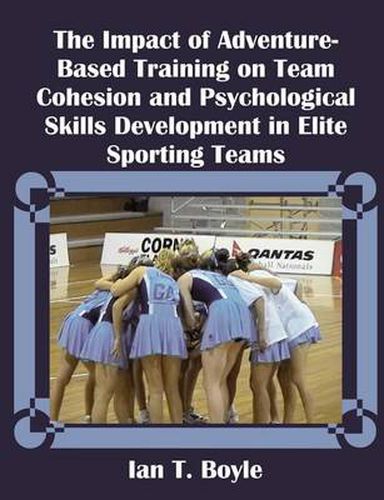
Adventure-based training has become an effective medium for delivering experiential training programs within a variety of disciplines such as; school outdoor education, corporate teamwork development, youth at risk and psychological counseling. In addition, Meyer & Wenger (1998) and Meyer (2000) were instrumental in pioneering research in to the efficacy of adventure-based training with sporting teams. This investigation adds to the growing body of knowledge in this area by demonstrating the positive effects an adventure training intervention has on athletes ability to learn new team and psychological skills. In addition, results indicated that individual and team performance might have been enhanced because of skills learnt during the intervention. This study examined the impact of an adventure-based training intervention on the group cohesion and psychological skills development of elite netball players. Data was gathered using both quantitative and qualitative methodologies. Many researchers are of the belief that the two methodologies compliment one another and thereby strengthen the total research model (Henderson, 1993). A phenomenological approach to qualitative data collection was followed based on the work by Dale (1996). Knowing how the intervention impacted on the participants from their perspective, is a critical question often overlooked by researchers. Results clearly indicated how athletes changed and developed during and after the intervention. Improved cohesion around task issues was especially evident, along with enhanced mental skills to handle the pressures of major competition. Lewin s change theory was examined to explain the learning process; modifications to this theory were suggested. Recommendations were outlined for improving sport psychology teaching practice, along with improved facilitation of adventure programming.
$9.00 standard shipping within Australia
FREE standard shipping within Australia for orders over $100.00
Express & International shipping calculated at checkout
Stock availability can be subject to change without notice. We recommend calling the shop or contacting our online team to check availability of low stock items. Please see our Shopping Online page for more details.
This title is printed to order. This book may have been self-published. If so, we cannot guarantee the quality of the content. In the main most books will have gone through the editing process however some may not. We therefore suggest that you be aware of this before ordering this book. If in doubt check either the author or publisher’s details as we are unable to accept any returns unless they are faulty. Please contact us if you have any questions.
Adventure-based training has become an effective medium for delivering experiential training programs within a variety of disciplines such as; school outdoor education, corporate teamwork development, youth at risk and psychological counseling. In addition, Meyer & Wenger (1998) and Meyer (2000) were instrumental in pioneering research in to the efficacy of adventure-based training with sporting teams. This investigation adds to the growing body of knowledge in this area by demonstrating the positive effects an adventure training intervention has on athletes ability to learn new team and psychological skills. In addition, results indicated that individual and team performance might have been enhanced because of skills learnt during the intervention. This study examined the impact of an adventure-based training intervention on the group cohesion and psychological skills development of elite netball players. Data was gathered using both quantitative and qualitative methodologies. Many researchers are of the belief that the two methodologies compliment one another and thereby strengthen the total research model (Henderson, 1993). A phenomenological approach to qualitative data collection was followed based on the work by Dale (1996). Knowing how the intervention impacted on the participants from their perspective, is a critical question often overlooked by researchers. Results clearly indicated how athletes changed and developed during and after the intervention. Improved cohesion around task issues was especially evident, along with enhanced mental skills to handle the pressures of major competition. Lewin s change theory was examined to explain the learning process; modifications to this theory were suggested. Recommendations were outlined for improving sport psychology teaching practice, along with improved facilitation of adventure programming.
Search our extensive online catalogue.
