Readings Newsletter
Become a Readings Member to make your shopping experience even easier.
Sign in or sign up for free!
You’re not far away from qualifying for FREE standard shipping within Australia
You’ve qualified for FREE standard shipping within Australia
The cart is loading…


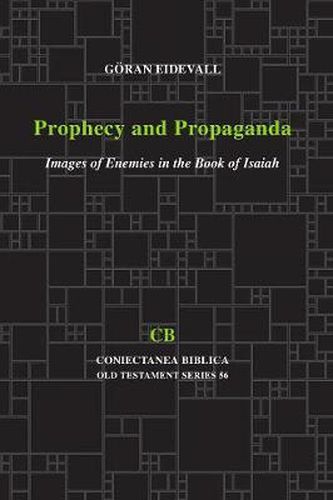
Isaiah contains a rich variety of enemy images from a time span covering at least four centuries. Eidevall’s textual analysis in Prophecy and Propaganda focuses on the characterization of the enemy, the rhetorical strategy adopted, the text’s function in its historical context(s), and the ideology of the author(s) and/or editor(s). The main part of the study begins with textual analyses of passages dealing with the hostile empires of Assyria, Babylon, and Egypt. It then turns to Judah’s northern neighbors, Ephraim/Israel and Aram, formed another hostile alliance against Judah, and how oracles directed against Samaria took on new significance in the postexilic era, due to the emerging schism between Samaritans and other Jews. The portrait of Moab is intriguingly ambiguous, but the picture of Edom is uncompromisingly negative. Finally, the study investigates anonymous enemies of various kinds, who are often characterized as rebels deserving severe punishment. The final editors of Isaiah wanted to discourage a wide range of actions and attitudes that, according to their standards, amounted to opposition to YHWH by YHWH worshipers themselves.
Ideological language, such as the Zion-centered perspective and the legendary version of the events in 701 BCE, is paradigmatic in Isaiah, raising the question to what extent the prophecies therein can be understood as instances of contextually determined (and continually reworked and reinterpreted) political propaganda. The final editors belonged to a party supporting the religious politics of Ezra and Nehemiah. Although they describe themselves as humble servants and as marginalized victims of persecution, it is likely that they actually represented circles with access to the power structures of their time.
A must-read for anyone studying perspectives on Isaiah in scholarly research today.
$9.00 standard shipping within Australia
FREE standard shipping within Australia for orders over $100.00
Express & International shipping calculated at checkout
Stock availability can be subject to change without notice. We recommend calling the shop or contacting our online team to check availability of low stock items. Please see our Shopping Online page for more details.
Isaiah contains a rich variety of enemy images from a time span covering at least four centuries. Eidevall’s textual analysis in Prophecy and Propaganda focuses on the characterization of the enemy, the rhetorical strategy adopted, the text’s function in its historical context(s), and the ideology of the author(s) and/or editor(s). The main part of the study begins with textual analyses of passages dealing with the hostile empires of Assyria, Babylon, and Egypt. It then turns to Judah’s northern neighbors, Ephraim/Israel and Aram, formed another hostile alliance against Judah, and how oracles directed against Samaria took on new significance in the postexilic era, due to the emerging schism between Samaritans and other Jews. The portrait of Moab is intriguingly ambiguous, but the picture of Edom is uncompromisingly negative. Finally, the study investigates anonymous enemies of various kinds, who are often characterized as rebels deserving severe punishment. The final editors of Isaiah wanted to discourage a wide range of actions and attitudes that, according to their standards, amounted to opposition to YHWH by YHWH worshipers themselves.
Ideological language, such as the Zion-centered perspective and the legendary version of the events in 701 BCE, is paradigmatic in Isaiah, raising the question to what extent the prophecies therein can be understood as instances of contextually determined (and continually reworked and reinterpreted) political propaganda. The final editors belonged to a party supporting the religious politics of Ezra and Nehemiah. Although they describe themselves as humble servants and as marginalized victims of persecution, it is likely that they actually represented circles with access to the power structures of their time.
A must-read for anyone studying perspectives on Isaiah in scholarly research today.
Search our extensive online catalogue.
