Readings Newsletter
Become a Readings Member to make your shopping experience even easier.
Sign in or sign up for free!
You’re not far away from qualifying for FREE standard shipping within Australia
You’ve qualified for FREE standard shipping within Australia
The cart is loading…


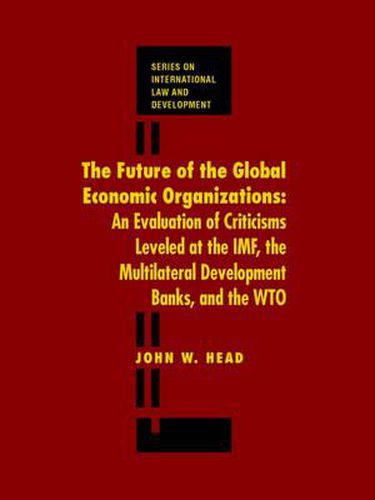
This book offers a skilled arms-length evaluation, from a legal perspective, of the main criticisms that have been leveled recently at the key global economic organizations - that is, the International Monetary Fund (IMF), the World Bank and its fellow multilateral developmental banks (MDBs), and the World Trade Organization (WTO).
THE FUTURE OF THE GLOBAL ECONOMIC ORGANIZATIONS stands out from most of the growing body of literature on the IMF, MDBS, and the WTO in two main respects: the book’s scope and the author’s experience. Whereas numerous commentators have focused on particular strengths and weaknesses of one or the other of the GEOs, and have argued for changes on the basis of specific areas of operation, this book takes a wider view to examine all the GEOs at once. This broader scope reveals commonalities in the criticisms. For example, complaints about so-called democracy deficit obviously can be applied to all GEOs but with different nuances in emphasis and sting.
Against the background of his own experience as a legal counsel for one of the regional MDBs and for the IMF and a legal career that has focused on international economic law, Head distills the swarm of complaints leveled at the IMF, MDBS, and the WTO into 25 specific criticisms and then offers succinct explanations of why some of those criticisms should be dismissed, why some of them are valid, and how those valid criticisms should form the basis for an important restructuring of the institutions, including amendments to the charters that establish and govern their operations. Head speaks largely to three audiences here: persons in various professional positions; persons in national governments and politics around the world who are responsible for implementing their government’s foreign policy; and to more general curious readers on whose involvement in civic life any society ultimately depends.
Published under the Transnational Publishers imprint.
$9.00 standard shipping within Australia
FREE standard shipping within Australia for orders over $100.00
Express & International shipping calculated at checkout
Stock availability can be subject to change without notice. We recommend calling the shop or contacting our online team to check availability of low stock items. Please see our Shopping Online page for more details.
This book offers a skilled arms-length evaluation, from a legal perspective, of the main criticisms that have been leveled recently at the key global economic organizations - that is, the International Monetary Fund (IMF), the World Bank and its fellow multilateral developmental banks (MDBs), and the World Trade Organization (WTO).
THE FUTURE OF THE GLOBAL ECONOMIC ORGANIZATIONS stands out from most of the growing body of literature on the IMF, MDBS, and the WTO in two main respects: the book’s scope and the author’s experience. Whereas numerous commentators have focused on particular strengths and weaknesses of one or the other of the GEOs, and have argued for changes on the basis of specific areas of operation, this book takes a wider view to examine all the GEOs at once. This broader scope reveals commonalities in the criticisms. For example, complaints about so-called democracy deficit obviously can be applied to all GEOs but with different nuances in emphasis and sting.
Against the background of his own experience as a legal counsel for one of the regional MDBs and for the IMF and a legal career that has focused on international economic law, Head distills the swarm of complaints leveled at the IMF, MDBS, and the WTO into 25 specific criticisms and then offers succinct explanations of why some of those criticisms should be dismissed, why some of them are valid, and how those valid criticisms should form the basis for an important restructuring of the institutions, including amendments to the charters that establish and govern their operations. Head speaks largely to three audiences here: persons in various professional positions; persons in national governments and politics around the world who are responsible for implementing their government’s foreign policy; and to more general curious readers on whose involvement in civic life any society ultimately depends.
Published under the Transnational Publishers imprint.
Search our extensive online catalogue.
