Readings Newsletter
Become a Readings Member to make your shopping experience even easier.
Sign in or sign up for free!
You’re not far away from qualifying for FREE standard shipping within Australia
You’ve qualified for FREE standard shipping within Australia
The cart is loading…


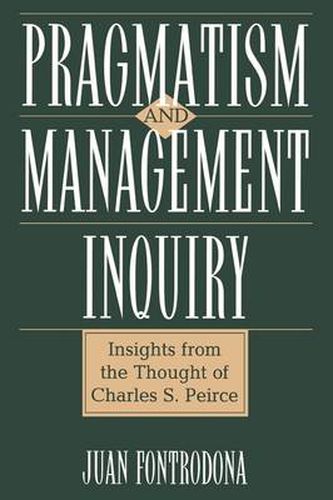
A cool, lucid examination of the thought of the American philosopher Charles S. Peirce, offering an important clarification and an innovative way to view human actions and the way management is practiced. Dr. Fontrodona examines the thought of the American philosopher Charles S. Peirce–who in 1872 gave name to a group of ideas that came to be known as pragmatism –and emerges with an important clarification and an innovative way to view human action and the practice of management. Peirce denied that as it was commonly understood, pramatism represented the triumph of pure effectiveness. Rather, it involves processes by which people, through action, reveal and develop themselves, and this involves virtues and values. Good managers are not just effective, they do not simply get things done, but they are ethical–they do the right things. Dr. Fontradona also shows how out of pragmatism’s sense of purpose a way can be found to define a theory of decision. As Dr. Michael Hoffman says in his Foreword, Peirce and Fontradona both find that action is understood and judged not only through operational techniques, but through intentions and the moral values that formulate and drive those intentions. Fontradona has produced a book of immense richness and value, he writes. It exposes…a fundamental truth of not only management theory but of all human action–that successful endeavor, which furthers the progress of business and of civilization generally, is dependent on the proper balance and dynamics of individulas, institutions, and integrity. [It] is not only a book for business and for scholars of Peirce, but truly a work with wisdom for living life itself. The book is divided into three parts. In the first part, Dr. Fontrodona focuses on the concept of action, based on some of the central features of Peirce’s thought. He considers human action not only from the viewpoint of its effectiveness, but also from its purposefulness. Human action, he asserts, is characterized by being driven by an intention, and this becomes explicit through the decision making process. Dr. Fontrodona turns to this in Part II. He says that Peirce’s thought about the nature of science allows us to consider that although management is eminently practical, it is based on a scientific approach. Then, in Part III, he presents three principles for human action drawn from the three normative sciences: creativity, based on logic; community, based on ethics; and character, based on aesthetics. He argues that creativity is the result of the logic of abduction, and contrasts with the instrumental rationality of the modern scientific method. Community emphasizes the social nature of knowledge, instead of the individualism of the modern moral attitude. And character proposes that human development is the ultimate end of human action taken against material enrichment. To close his book, Dr. Fontradona questions the presence of these principles in the commonly accepted, current models of management.
$9.00 standard shipping within Australia
FREE standard shipping within Australia for orders over $100.00
Express & International shipping calculated at checkout
Stock availability can be subject to change without notice. We recommend calling the shop or contacting our online team to check availability of low stock items. Please see our Shopping Online page for more details.
A cool, lucid examination of the thought of the American philosopher Charles S. Peirce, offering an important clarification and an innovative way to view human actions and the way management is practiced. Dr. Fontrodona examines the thought of the American philosopher Charles S. Peirce–who in 1872 gave name to a group of ideas that came to be known as pragmatism –and emerges with an important clarification and an innovative way to view human action and the practice of management. Peirce denied that as it was commonly understood, pramatism represented the triumph of pure effectiveness. Rather, it involves processes by which people, through action, reveal and develop themselves, and this involves virtues and values. Good managers are not just effective, they do not simply get things done, but they are ethical–they do the right things. Dr. Fontradona also shows how out of pragmatism’s sense of purpose a way can be found to define a theory of decision. As Dr. Michael Hoffman says in his Foreword, Peirce and Fontradona both find that action is understood and judged not only through operational techniques, but through intentions and the moral values that formulate and drive those intentions. Fontradona has produced a book of immense richness and value, he writes. It exposes…a fundamental truth of not only management theory but of all human action–that successful endeavor, which furthers the progress of business and of civilization generally, is dependent on the proper balance and dynamics of individulas, institutions, and integrity. [It] is not only a book for business and for scholars of Peirce, but truly a work with wisdom for living life itself. The book is divided into three parts. In the first part, Dr. Fontrodona focuses on the concept of action, based on some of the central features of Peirce’s thought. He considers human action not only from the viewpoint of its effectiveness, but also from its purposefulness. Human action, he asserts, is characterized by being driven by an intention, and this becomes explicit through the decision making process. Dr. Fontrodona turns to this in Part II. He says that Peirce’s thought about the nature of science allows us to consider that although management is eminently practical, it is based on a scientific approach. Then, in Part III, he presents three principles for human action drawn from the three normative sciences: creativity, based on logic; community, based on ethics; and character, based on aesthetics. He argues that creativity is the result of the logic of abduction, and contrasts with the instrumental rationality of the modern scientific method. Community emphasizes the social nature of knowledge, instead of the individualism of the modern moral attitude. And character proposes that human development is the ultimate end of human action taken against material enrichment. To close his book, Dr. Fontradona questions the presence of these principles in the commonly accepted, current models of management.
Search our extensive online catalogue.
