Readings Newsletter
Become a Readings Member to make your shopping experience even easier.
Sign in or sign up for free!
You’re not far away from qualifying for FREE standard shipping within Australia
You’ve qualified for FREE standard shipping within Australia
The cart is loading…


This title is printed to order. This book may have been self-published. If so, we cannot guarantee the quality of the content. In the main most books will have gone through the editing process however some may not. We therefore suggest that you be aware of this before ordering this book. If in doubt check either the author or publisher’s details as we are unable to accept any returns unless they are faulty. Please contact us if you have any questions.
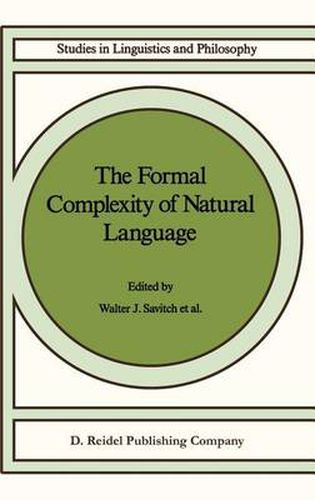
Ever since Chomsky laid the framework for a mathematically formal theory of syntax, two classes of formal models have held wide appeal. The finite state model offered simplicity. At the opposite extreme numerous very powerful models, most notable transformational grammar, offered generality. As soon as this mathematical framework was laid, devastating arguments were given by Chomsky and others indicating that the finite state model was woefully inadequate for the syntax of natural language. In response, the completely general transformational grammar model was advanced as a suitable vehicle for capturing the description of natural language syntax. While transformational grammar seems likely to be adequate to the task, many researchers have advanced the argument that it is too adequate.
A now classic result of Peters and Ritchie shows that the model of transformational grammar given in Chomsky’s Aspects [IJ is powerful indeed. So powerful as to allow it to describe any recursively enumerable set. In other words it can describe the syntax of any language that is describable by any algorithmic process whatsoever. This situation led many researchers to reasses the claim that natural languages are included in the class of transformational grammar languages. The conclu sion that many reached is that the claim is void of content, since, in their view, it says little more than that natural language syntax is doable algo rithmically and, in the framework of modern linguistics, psychology or neuroscience, that is axiomatic.
$9.00 standard shipping within Australia
FREE standard shipping within Australia for orders over $100.00
Express & International shipping calculated at checkout
Stock availability can be subject to change without notice. We recommend calling the shop or contacting our online team to check availability of low stock items. Please see our Shopping Online page for more details.
This title is printed to order. This book may have been self-published. If so, we cannot guarantee the quality of the content. In the main most books will have gone through the editing process however some may not. We therefore suggest that you be aware of this before ordering this book. If in doubt check either the author or publisher’s details as we are unable to accept any returns unless they are faulty. Please contact us if you have any questions.
Ever since Chomsky laid the framework for a mathematically formal theory of syntax, two classes of formal models have held wide appeal. The finite state model offered simplicity. At the opposite extreme numerous very powerful models, most notable transformational grammar, offered generality. As soon as this mathematical framework was laid, devastating arguments were given by Chomsky and others indicating that the finite state model was woefully inadequate for the syntax of natural language. In response, the completely general transformational grammar model was advanced as a suitable vehicle for capturing the description of natural language syntax. While transformational grammar seems likely to be adequate to the task, many researchers have advanced the argument that it is too adequate.
A now classic result of Peters and Ritchie shows that the model of transformational grammar given in Chomsky’s Aspects [IJ is powerful indeed. So powerful as to allow it to describe any recursively enumerable set. In other words it can describe the syntax of any language that is describable by any algorithmic process whatsoever. This situation led many researchers to reasses the claim that natural languages are included in the class of transformational grammar languages. The conclu sion that many reached is that the claim is void of content, since, in their view, it says little more than that natural language syntax is doable algo rithmically and, in the framework of modern linguistics, psychology or neuroscience, that is axiomatic.
Search our extensive online catalogue.
