

Reporting World War II, (9781531503093) — Readings Books
Reporting World War II
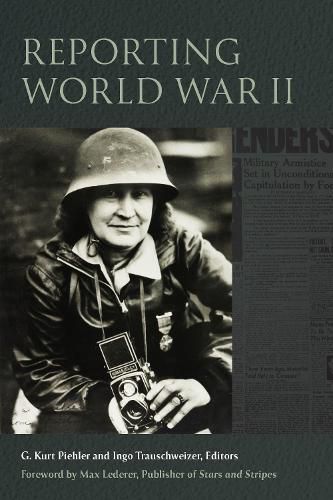
Hardback

Reporting World War II

$361.99
Sign in or become a Readings Member to add this title to your wishlist.

This set of essays offers new insights into the journalistic process and the pressures American front-line reporters experienced covering World War II. Transmitting stories through cable or couriers remained expensive and often required the cooperation of foreign governments and the American armed forces. Initially, reporters from a neutral America documented the early victories by Nazi Germany and the Soviet invasion of Finland. Not all journalists strived for objectivity. During her time reporting from Ireland, Helen Kirkpatrick remained a fierce critic of this country’s neutrality. Once the United States joined the fight after the Japanese attack on Pearl Harbor, American journalists supported the struggle against the Axis powers, but this volume will show that reporters, even when members of the army sponsored, Stars and Stripes were not mere ciphers of the official line.

African American reporters Roi Ottley and Ollie Stewart worked to bolster the morale of Black GIs and they undermine the institutional racism endemic to the American war effort. Women front-line reporters are given their due in this volume examining the struggles to overcome gender bias by examining triumphs of Therese Mabel Bonney, Lee Carson, Iris Carpenter, Lee Carson, and Anne Stringer.

The line between public relations and journalism could be a fine one as reflected by the U.S. Marine Corps creating its own network of Marine correspondents who reported on the Pacific island campaigns and had their work published by American media outlets. Despite the pressures of censorship, the best American reporters strove for accuracy in reporting the facts even when dependent on official communiques issued by the military. Many war-time reporters, even when covering major turning points, sought to embrace a reporting style that recorded the experiences of average soldiers. Often associated with Ernie Pyle and Bill Mauldin, the embrace of the human-interest story served as one of the enduring legacies of the conflict.

Despite the importance of American war reporting in shaping perceptions of the war on the home front as well as shaping the historical narrative of this conflict, this work underscores how there is more to learn. Readers will gain from this work and new appreciation of the contribution of American journalists in writing the first version of history as the global struggle against Nazi Germany, Imperial Japan, and Fascist Italy.

Read More
In Shop
Out of stock
Shipping & Delivery

$9.00 standard shipping within Australia
FREE standard shipping within Australia for orders over $100.00
Express & International shipping calculated at checkout

MORE INFO

Stock availability can be subject to change without notice. We recommend calling the shop or contacting our online team to check availability of low stock items. Please see our Shopping Online page for more details.

Format
Hardback
Publisher
Fordham University Press
Country
United States
Date
25 April 2023
Pages
304
ISBN
9781531503093

This set of essays offers new insights into the journalistic process and the pressures American front-line reporters experienced covering World War II. Transmitting stories through cable or couriers remained expensive and often required the cooperation of foreign governments and the American armed forces. Initially, reporters from a neutral America documented the early victories by Nazi Germany and the Soviet invasion of Finland. Not all journalists strived for objectivity. During her time reporting from Ireland, Helen Kirkpatrick remained a fierce critic of this country’s neutrality. Once the United States joined the fight after the Japanese attack on Pearl Harbor, American journalists supported the struggle against the Axis powers, but this volume will show that reporters, even when members of the army sponsored, Stars and Stripes were not mere ciphers of the official line.

African American reporters Roi Ottley and Ollie Stewart worked to bolster the morale of Black GIs and they undermine the institutional racism endemic to the American war effort. Women front-line reporters are given their due in this volume examining the struggles to overcome gender bias by examining triumphs of Therese Mabel Bonney, Lee Carson, Iris Carpenter, Lee Carson, and Anne Stringer.

The line between public relations and journalism could be a fine one as reflected by the U.S. Marine Corps creating its own network of Marine correspondents who reported on the Pacific island campaigns and had their work published by American media outlets. Despite the pressures of censorship, the best American reporters strove for accuracy in reporting the facts even when dependent on official communiques issued by the military. Many war-time reporters, even when covering major turning points, sought to embrace a reporting style that recorded the experiences of average soldiers. Often associated with Ernie Pyle and Bill Mauldin, the embrace of the human-interest story served as one of the enduring legacies of the conflict.

Despite the importance of American war reporting in shaping perceptions of the war on the home front as well as shaping the historical narrative of this conflict, this work underscores how there is more to learn. Readers will gain from this work and new appreciation of the contribution of American journalists in writing the first version of history as the global struggle against Nazi Germany, Imperial Japan, and Fascist Italy.

Read More
Format
Hardback
Publisher
Fordham University Press
Country
United States
Date
25 April 2023
Pages
304
ISBN
9781531503093