Readings Newsletter
Become a Readings Member to make your shopping experience even easier.
Sign in or sign up for free!
You’re not far away from qualifying for FREE standard shipping within Australia
You’ve qualified for FREE standard shipping within Australia
The cart is loading…


Although there are numerous books on alternative accounting methods, such as Lean accounting, none focus on the impact of time and how accounting practices can be modified to acknowledge the power of time. This book addresses this need.
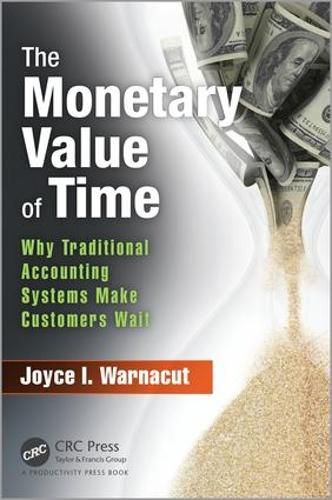
The Monetary Value of Time: Why Traditional Accounting Systems Make Customers Wait presents a framework for assessing the value of time in terms of organizational strategy and competitive advantage. The framework presented will enable organizations to develop consistent measures and ensure that their cost accounting system isn’t motivating behaviors that add to lead time and make customers wait.
The framework outlined in this book is relevant to the managerial and cost accounting practices in today’s manufacturing environment, which is increasingly moving away from mass production to custom manufacturing. The framework is supported by high-level metrics, which are reinforced by operational metrics. This is supported by accounting data that recognize the value of time. Pricing models that incorporate the concept of time are presented.
The book provides many examples of how the use of standard costing and traditional accounting practices in a high-mix/low-volume production environment can produce contradictory or even inaccurate results that form the basis for poor decisions that may actually move your organization farther from its objectives.
The book arms readers with options for overcoming traditional barriers by applying direct costs at an item level, while applying overheads at a macro or value stream level. For example, while GAAP requires overhead application for inventory valuation, a common misconception is that overhead must be applied at an item level. In fact, overhead can be absorbed by one journal entry.
Demonstrating the linkages between time-based accounting data and meaningful business metrics that drive bottom line results, the book presents methods and metrics that have been successfully applied by the author in manufacturing environments.
$9.00 standard shipping within Australia
FREE standard shipping within Australia for orders over $100.00
Express & International shipping calculated at checkout
Stock availability can be subject to change without notice. We recommend calling the shop or contacting our online team to check availability of low stock items. Please see our Shopping Online page for more details.
Although there are numerous books on alternative accounting methods, such as Lean accounting, none focus on the impact of time and how accounting practices can be modified to acknowledge the power of time. This book addresses this need.
The Monetary Value of Time: Why Traditional Accounting Systems Make Customers Wait presents a framework for assessing the value of time in terms of organizational strategy and competitive advantage. The framework presented will enable organizations to develop consistent measures and ensure that their cost accounting system isn’t motivating behaviors that add to lead time and make customers wait.
The framework outlined in this book is relevant to the managerial and cost accounting practices in today’s manufacturing environment, which is increasingly moving away from mass production to custom manufacturing. The framework is supported by high-level metrics, which are reinforced by operational metrics. This is supported by accounting data that recognize the value of time. Pricing models that incorporate the concept of time are presented.
The book provides many examples of how the use of standard costing and traditional accounting practices in a high-mix/low-volume production environment can produce contradictory or even inaccurate results that form the basis for poor decisions that may actually move your organization farther from its objectives.
The book arms readers with options for overcoming traditional barriers by applying direct costs at an item level, while applying overheads at a macro or value stream level. For example, while GAAP requires overhead application for inventory valuation, a common misconception is that overhead must be applied at an item level. In fact, overhead can be absorbed by one journal entry.
Demonstrating the linkages between time-based accounting data and meaningful business metrics that drive bottom line results, the book presents methods and metrics that have been successfully applied by the author in manufacturing environments.
Search our extensive online catalogue.
