Readings Newsletter
Become a Readings Member to make your shopping experience even easier.
Sign in or sign up for free!
You’re not far away from qualifying for FREE standard shipping within Australia
You’ve qualified for FREE standard shipping within Australia
The cart is loading…


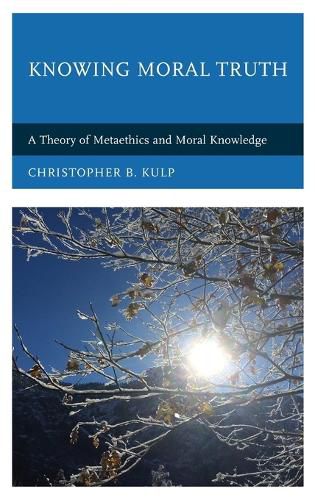
This is a book on metaethics and moral epistemology. It asks two fundamental questions: (i) Is there any such thing as (non-relative) moral truth?; and (ii) If there is such truth, how do we come into epistemic contact with it? Roughly the first half of the book is aimed at answering the first question. Its animating idea is that we should take our ordinary, tutored moral judgments seriously-judgments typified by our conviction that it is clearly true that some acts, policies, social norms et al. are morally right or wrong, permissible or impermissible, praiseworthy or condemnable, etc., no matter when, where, or by whom they are performed.
In order to provide a firm conceptual basis for such judgments, the book develops a theory of moral truth, based on a theory of moral facts. The account of moral truth and moral facts is further grounded on a theory of moral properties. In short, the book develops a theory of moral realism, roughly, the view that there are indeed non-relative, first-order moral truths. The second half of the book is aimed at answering the second question above. Building squarely on the metaethical theories developed earlier, the book argues for a non-empiricist theory of justified moral belief and knowledge. Pivotal to this project is a careful analysis of various forms of moral skepticism, by which I mean any conception of morality substantially at odds with the general contours of our ordinary moral thinking. All such skepticisms are rejected, and in their place a broadly intuitionist, epistemically fallibilist theory of moral knowledge is advanced. The conclusion reached is that we have very strong reason to believe that our ordinary moral thinking, although certainly liable to error, is fundamentally sound. Moral knowledge is ubiquitous.
$9.00 standard shipping within Australia
FREE standard shipping within Australia for orders over $100.00
Express & International shipping calculated at checkout
Stock availability can be subject to change without notice. We recommend calling the shop or contacting our online team to check availability of low stock items. Please see our Shopping Online page for more details.
This is a book on metaethics and moral epistemology. It asks two fundamental questions: (i) Is there any such thing as (non-relative) moral truth?; and (ii) If there is such truth, how do we come into epistemic contact with it? Roughly the first half of the book is aimed at answering the first question. Its animating idea is that we should take our ordinary, tutored moral judgments seriously-judgments typified by our conviction that it is clearly true that some acts, policies, social norms et al. are morally right or wrong, permissible or impermissible, praiseworthy or condemnable, etc., no matter when, where, or by whom they are performed.
In order to provide a firm conceptual basis for such judgments, the book develops a theory of moral truth, based on a theory of moral facts. The account of moral truth and moral facts is further grounded on a theory of moral properties. In short, the book develops a theory of moral realism, roughly, the view that there are indeed non-relative, first-order moral truths. The second half of the book is aimed at answering the second question above. Building squarely on the metaethical theories developed earlier, the book argues for a non-empiricist theory of justified moral belief and knowledge. Pivotal to this project is a careful analysis of various forms of moral skepticism, by which I mean any conception of morality substantially at odds with the general contours of our ordinary moral thinking. All such skepticisms are rejected, and in their place a broadly intuitionist, epistemically fallibilist theory of moral knowledge is advanced. The conclusion reached is that we have very strong reason to believe that our ordinary moral thinking, although certainly liable to error, is fundamentally sound. Moral knowledge is ubiquitous.
Search our extensive online catalogue.
