Readings Newsletter
Become a Readings Member to make your shopping experience even easier.
Sign in or sign up for free!
You’re not far away from qualifying for FREE standard shipping within Australia
You’ve qualified for FREE standard shipping within Australia
The cart is loading…


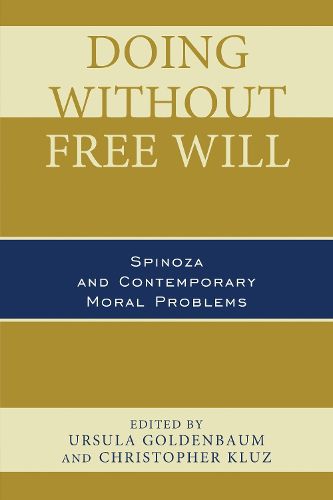
Doing without Free Will: Spinoza and Contemporary Moral Problems introduces Spinoza into the contemporary discussion on free will and on moral problems surrounding this discussion. Traditional Western moral philosophy, for the most part, has been built on the assumption of free will as a special human capacity to freely choose actions without being determined in that choice. This idea draws increasing critique, fueled recently especially by the ever new findings of neuroscience. But how can we develop a moral philosophy without free will?
Spinoza faced a similar challenge when writing his Ethics during the rise of modern science and its deterministic model of nature and, for this reason, has much to offer the current discussion. Not only does he provide a foundation for understanding moral responsibility without free will, he also provides an explanation and solution to the classical problem of akrasia precisely because he argues the will is not free. He worked out an entirely new system of moral philosophy that can help resolve the meta-ethical dilemma between absolutism and relativism, showing how moral values evolve naturally within society.
Despite denying the traditional God-like power of free will Spinoza developed a robust concept of freedom, one that is distinctly human and viable today. His modernity comes to light when we look at his answers to the much discussed questions whether it is possible or even desirable to develop objective instead of reactive attitudes toward our fellow human beings. His answers, perhaps surprisingly, resemble positions held by some contemporary philosophers.
$9.00 standard shipping within Australia
FREE standard shipping within Australia for orders over $100.00
Express & International shipping calculated at checkout
Stock availability can be subject to change without notice. We recommend calling the shop or contacting our online team to check availability of low stock items. Please see our Shopping Online page for more details.
Doing without Free Will: Spinoza and Contemporary Moral Problems introduces Spinoza into the contemporary discussion on free will and on moral problems surrounding this discussion. Traditional Western moral philosophy, for the most part, has been built on the assumption of free will as a special human capacity to freely choose actions without being determined in that choice. This idea draws increasing critique, fueled recently especially by the ever new findings of neuroscience. But how can we develop a moral philosophy without free will?
Spinoza faced a similar challenge when writing his Ethics during the rise of modern science and its deterministic model of nature and, for this reason, has much to offer the current discussion. Not only does he provide a foundation for understanding moral responsibility without free will, he also provides an explanation and solution to the classical problem of akrasia precisely because he argues the will is not free. He worked out an entirely new system of moral philosophy that can help resolve the meta-ethical dilemma between absolutism and relativism, showing how moral values evolve naturally within society.
Despite denying the traditional God-like power of free will Spinoza developed a robust concept of freedom, one that is distinctly human and viable today. His modernity comes to light when we look at his answers to the much discussed questions whether it is possible or even desirable to develop objective instead of reactive attitudes toward our fellow human beings. His answers, perhaps surprisingly, resemble positions held by some contemporary philosophers.
Search our extensive online catalogue.
