Readings Newsletter
Become a Readings Member to make your shopping experience even easier.
Sign in or sign up for free!
You’re not far away from qualifying for FREE standard shipping within Australia
You’ve qualified for FREE standard shipping within Australia
The cart is loading…


This title is printed to order. This book may have been self-published. If so, we cannot guarantee the quality of the content. In the main most books will have gone through the editing process however some may not. We therefore suggest that you be aware of this before ordering this book. If in doubt check either the author or publisher’s details as we are unable to accept any returns unless they are faulty. Please contact us if you have any questions.
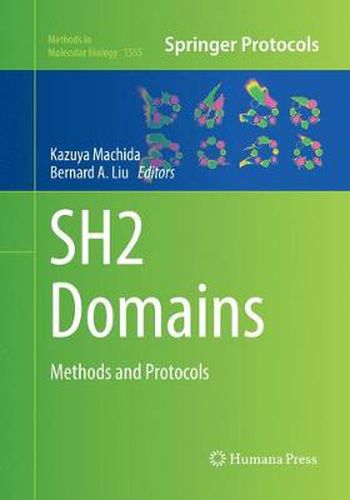
This volume covers an array of techniques available for studying SH2 domains and phosphotyrosine signaling. The book is divided into six parts: Part I outlines the history of SH2, technology development, and cell signaling; Part II focuses on computational approaches and tools used for identification, classification, and predictions of SH2 domain binding partners; Part III details various ways to prepare the SH2 domains as experimental reagents; Part IV presents methods for structural analysis and conventional binding assays using SH2 domains; Part V describes high-throughput and proteomics approaches to aid in analyzing SH2-mediated interactions; and Part VI covers applications for SH2 domain to functional and imaging analyzes. Written in the highly successful Methods in Molecular Biology series format, chapters include introductions to their respective topics, lists of the necessary materials and reagents, step-by-step, readily reproducible laboratory protocols, and tips on troubleshooting and avoiding known pitfalls.
Cutting-edge and thorough, SH2 Domains: Methods and Protocols is a valuable resource for computational biologists, biochemists, structural biologists, cell biologists, pathologists, and people interested in SH2 domains and phosphotyrosine signaling. Researchers who are investigating how protein interaction domain mediate specificity in signaling systems may also find this book informative.
$9.00 standard shipping within Australia
FREE standard shipping within Australia for orders over $100.00
Express & International shipping calculated at checkout
Stock availability can be subject to change without notice. We recommend calling the shop or contacting our online team to check availability of low stock items. Please see our Shopping Online page for more details.
This title is printed to order. This book may have been self-published. If so, we cannot guarantee the quality of the content. In the main most books will have gone through the editing process however some may not. We therefore suggest that you be aware of this before ordering this book. If in doubt check either the author or publisher’s details as we are unable to accept any returns unless they are faulty. Please contact us if you have any questions.
This volume covers an array of techniques available for studying SH2 domains and phosphotyrosine signaling. The book is divided into six parts: Part I outlines the history of SH2, technology development, and cell signaling; Part II focuses on computational approaches and tools used for identification, classification, and predictions of SH2 domain binding partners; Part III details various ways to prepare the SH2 domains as experimental reagents; Part IV presents methods for structural analysis and conventional binding assays using SH2 domains; Part V describes high-throughput and proteomics approaches to aid in analyzing SH2-mediated interactions; and Part VI covers applications for SH2 domain to functional and imaging analyzes. Written in the highly successful Methods in Molecular Biology series format, chapters include introductions to their respective topics, lists of the necessary materials and reagents, step-by-step, readily reproducible laboratory protocols, and tips on troubleshooting and avoiding known pitfalls.
Cutting-edge and thorough, SH2 Domains: Methods and Protocols is a valuable resource for computational biologists, biochemists, structural biologists, cell biologists, pathologists, and people interested in SH2 domains and phosphotyrosine signaling. Researchers who are investigating how protein interaction domain mediate specificity in signaling systems may also find this book informative.
Search our extensive online catalogue.
