Readings Newsletter
Become a Readings Member to make your shopping experience even easier.
Sign in or sign up for free!
You’re not far away from qualifying for FREE standard shipping within Australia
You’ve qualified for FREE standard shipping within Australia
The cart is loading…


This title is printed to order. This book may have been self-published. If so, we cannot guarantee the quality of the content. In the main most books will have gone through the editing process however some may not. We therefore suggest that you be aware of this before ordering this book. If in doubt check either the author or publisher’s details as we are unable to accept any returns unless they are faulty. Please contact us if you have any questions.
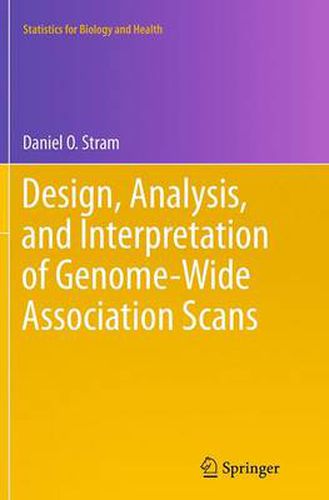
This book presents the statistical aspects of designing, analyzing and interpreting the results of genome-wide association scans (GWAS studies) for genetic causes of disease using unrelated subjects. Particular detail is given to the practical aspects of employing the bioinformatics and data handling methods necessary to prepare data for statistical analysis. The goal in writing this book is to give statisticians, epidemiologists, and students in these fields the tools to design a powerful genome-wide study based on current technology. The other part of this is showing readers how to conduct analysis of the created study.
Design and Analysis of Genome-Wide Association Studies provides a compendium of well-established statistical methods based upon single SNP associations. It also provides an introduction to more advanced statistical methods and issues. Knowing that technology, for instance large scale SNP arrays, is quickly changing, this text has significant lessons for future use with sequencing data. Emphasis on statistical concepts that apply to the problem of finding disease associations irrespective of the technology ensures its future applications. The author includes current bioinformatics tools while outlining the tools that will be required for use with extensive databases from future large scale sequencing projects. The author includes current bioinformatics tools while outlining additional issues and needs arising from the extensive databases from future large scale sequencing projects.
$9.00 standard shipping within Australia
FREE standard shipping within Australia for orders over $100.00
Express & International shipping calculated at checkout
Stock availability can be subject to change without notice. We recommend calling the shop or contacting our online team to check availability of low stock items. Please see our Shopping Online page for more details.
This title is printed to order. This book may have been self-published. If so, we cannot guarantee the quality of the content. In the main most books will have gone through the editing process however some may not. We therefore suggest that you be aware of this before ordering this book. If in doubt check either the author or publisher’s details as we are unable to accept any returns unless they are faulty. Please contact us if you have any questions.
This book presents the statistical aspects of designing, analyzing and interpreting the results of genome-wide association scans (GWAS studies) for genetic causes of disease using unrelated subjects. Particular detail is given to the practical aspects of employing the bioinformatics and data handling methods necessary to prepare data for statistical analysis. The goal in writing this book is to give statisticians, epidemiologists, and students in these fields the tools to design a powerful genome-wide study based on current technology. The other part of this is showing readers how to conduct analysis of the created study.
Design and Analysis of Genome-Wide Association Studies provides a compendium of well-established statistical methods based upon single SNP associations. It also provides an introduction to more advanced statistical methods and issues. Knowing that technology, for instance large scale SNP arrays, is quickly changing, this text has significant lessons for future use with sequencing data. Emphasis on statistical concepts that apply to the problem of finding disease associations irrespective of the technology ensures its future applications. The author includes current bioinformatics tools while outlining the tools that will be required for use with extensive databases from future large scale sequencing projects. The author includes current bioinformatics tools while outlining additional issues and needs arising from the extensive databases from future large scale sequencing projects.
Search our extensive online catalogue.
