Readings Newsletter
Become a Readings Member to make your shopping experience even easier.
Sign in or sign up for free!
You’re not far away from qualifying for FREE standard shipping within Australia
You’ve qualified for FREE standard shipping within Australia
The cart is loading…


This title is printed to order. This book may have been self-published. If so, we cannot guarantee the quality of the content. In the main most books will have gone through the editing process however some may not. We therefore suggest that you be aware of this before ordering this book. If in doubt check either the author or publisher’s details as we are unable to accept any returns unless they are faulty. Please contact us if you have any questions.
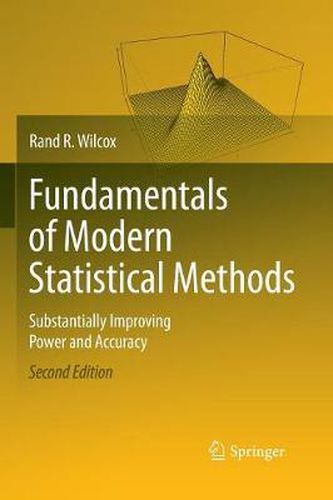
Conventional statistical methods have a very serious flaw. They routinely miss differences among groups or associations among variables that are detected by more modern techniques, even under very small departures from normality. Hundreds of journal articles have described the reasons standard techniques can be unsatisfactory, but simple, intuitive explanations are generally unavailable. Situations arise where even highly nonsignificant results become significant when analyzed with more modern methods.
Without assuming the reader has any prior training in statistics, Part I of this book describes basic statistical principles from a point of view that makes their shortcomings intuitive and easy to understand. The emphasis is on verbal and graphical descriptions of concepts. Part II describes modern methods that address the problems covered in Part I. Using data from actual studies, many examples are included to illustrate the practical problems with conventional procedures and how more modern methods can make a substantial difference in the conclusions reached in many areas of statistical research.
The second edition of this book includes a number of advances and insights that have occurred since the first edition appeared. Included are new results relevant to medians, regression, measures of association, strategies for comparing dependent groups, methods for dealing with heteroscedasticity, and measures of effect size.
$9.00 standard shipping within Australia
FREE standard shipping within Australia for orders over $100.00
Express & International shipping calculated at checkout
Stock availability can be subject to change without notice. We recommend calling the shop or contacting our online team to check availability of low stock items. Please see our Shopping Online page for more details.
This title is printed to order. This book may have been self-published. If so, we cannot guarantee the quality of the content. In the main most books will have gone through the editing process however some may not. We therefore suggest that you be aware of this before ordering this book. If in doubt check either the author or publisher’s details as we are unable to accept any returns unless they are faulty. Please contact us if you have any questions.
Conventional statistical methods have a very serious flaw. They routinely miss differences among groups or associations among variables that are detected by more modern techniques, even under very small departures from normality. Hundreds of journal articles have described the reasons standard techniques can be unsatisfactory, but simple, intuitive explanations are generally unavailable. Situations arise where even highly nonsignificant results become significant when analyzed with more modern methods.
Without assuming the reader has any prior training in statistics, Part I of this book describes basic statistical principles from a point of view that makes their shortcomings intuitive and easy to understand. The emphasis is on verbal and graphical descriptions of concepts. Part II describes modern methods that address the problems covered in Part I. Using data from actual studies, many examples are included to illustrate the practical problems with conventional procedures and how more modern methods can make a substantial difference in the conclusions reached in many areas of statistical research.
The second edition of this book includes a number of advances and insights that have occurred since the first edition appeared. Included are new results relevant to medians, regression, measures of association, strategies for comparing dependent groups, methods for dealing with heteroscedasticity, and measures of effect size.
Search our extensive online catalogue.
