Readings Newsletter
Become a Readings Member to make your shopping experience even easier.
Sign in or sign up for free!
You’re not far away from qualifying for FREE standard shipping within Australia
You’ve qualified for FREE standard shipping within Australia
The cart is loading…


This title is printed to order. This book may have been self-published. If so, we cannot guarantee the quality of the content. In the main most books will have gone through the editing process however some may not. We therefore suggest that you be aware of this before ordering this book. If in doubt check either the author or publisher’s details as we are unable to accept any returns unless they are faulty. Please contact us if you have any questions.
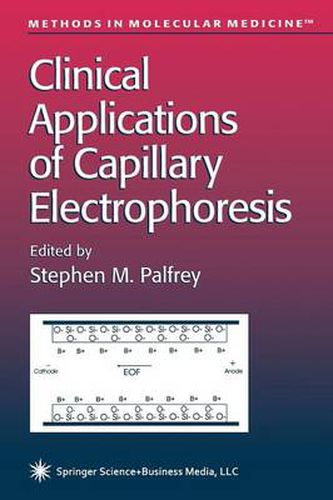
The term electrophoresis was first used by Michaelis in 1909, to - scribe the migration of colloids in an electric field. The first practical elect- phoresis method was described by Tiselius in 1937. He used a U-tube filled with buffer layered on top of sample; migration could be monitored using Schlieren optics. In zone electrophoresis, the U-tube was replaced by paper, a support material employed simply to prevent or minimize diffusion of ions, so that ions applied in a narrow strip to the paper will separate and remain as relatively discrete zones. Paper was superceded by a variety of other media, - cluding cellulose acetate, hydrolyzed starch (starch gel), agarose, and polyacry- mide. The latter, in addition to being a support medium, has size-sieving properties. From the basic zone electrophoresis, other means of separation have been dev- oped. These include, isoelectric focusing, isotachophoresis, density gradient el- trophoresis, and various forms of immunoelectrophoresis. In some ways Capillary Electrophoresis (CE) has gone full circle back to the original method of Tiselius. In its simplest form, separations occur in a buffer solution within a glass (fused silica) tube and detection occurs as sample moves past an optical window. CE has rapidly developed into a technique that rivals HPLC in its versatility. All the classical electrophoretic separations-zone, IEF, and isotachophoresis-have their counterparts in CE. Excitingly so, and - thoritatively treated in Clinical Applications of Capillary Electrophoresis.
$9.00 standard shipping within Australia
FREE standard shipping within Australia for orders over $100.00
Express & International shipping calculated at checkout
Stock availability can be subject to change without notice. We recommend calling the shop or contacting our online team to check availability of low stock items. Please see our Shopping Online page for more details.
This title is printed to order. This book may have been self-published. If so, we cannot guarantee the quality of the content. In the main most books will have gone through the editing process however some may not. We therefore suggest that you be aware of this before ordering this book. If in doubt check either the author or publisher’s details as we are unable to accept any returns unless they are faulty. Please contact us if you have any questions.
The term electrophoresis was first used by Michaelis in 1909, to - scribe the migration of colloids in an electric field. The first practical elect- phoresis method was described by Tiselius in 1937. He used a U-tube filled with buffer layered on top of sample; migration could be monitored using Schlieren optics. In zone electrophoresis, the U-tube was replaced by paper, a support material employed simply to prevent or minimize diffusion of ions, so that ions applied in a narrow strip to the paper will separate and remain as relatively discrete zones. Paper was superceded by a variety of other media, - cluding cellulose acetate, hydrolyzed starch (starch gel), agarose, and polyacry- mide. The latter, in addition to being a support medium, has size-sieving properties. From the basic zone electrophoresis, other means of separation have been dev- oped. These include, isoelectric focusing, isotachophoresis, density gradient el- trophoresis, and various forms of immunoelectrophoresis. In some ways Capillary Electrophoresis (CE) has gone full circle back to the original method of Tiselius. In its simplest form, separations occur in a buffer solution within a glass (fused silica) tube and detection occurs as sample moves past an optical window. CE has rapidly developed into a technique that rivals HPLC in its versatility. All the classical electrophoretic separations-zone, IEF, and isotachophoresis-have their counterparts in CE. Excitingly so, and - thoritatively treated in Clinical Applications of Capillary Electrophoresis.
Search our extensive online catalogue.
