Readings Newsletter
Become a Readings Member to make your shopping experience even easier.
Sign in or sign up for free!
You’re not far away from qualifying for FREE standard shipping within Australia
You’ve qualified for FREE standard shipping within Australia
The cart is loading…


This title is printed to order. This book may have been self-published. If so, we cannot guarantee the quality of the content. In the main most books will have gone through the editing process however some may not. We therefore suggest that you be aware of this before ordering this book. If in doubt check either the author or publisher’s details as we are unable to accept any returns unless they are faulty. Please contact us if you have any questions.
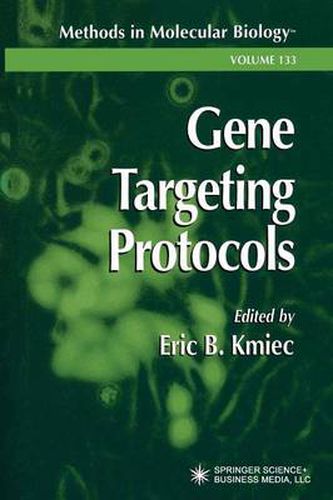
The potential now exists in many experimental systems to transfer a cloned, modified gene back into the genome of the host organism. In the ideal situation, the cloned gene is returned to its homologous location in the genome and becomes inserted at the target locus. This process is a controlled means for the repair of DNA damage and ensures accurate chromosome disjunction during meiosis. The paradigm for thinking about the mechanism of this p- cess has emerged primarily from two sources: (1) The principles of reaction mechanics have come from detailed biochemical analyses of the RecA protein purified from Escherichia coli; and (2) the principles of information transfer have been derived from genetic studies carried out in bacteriophage and fungi. A compelling picture of the process of homologous pairing and DNA strand exchange has been influential in directing investigators interested in gene t- geting experiments. The ability to find and pair homologous DNA molecules enables ac- rate gene targeting and is the central phenomenon underlying genetic recombi- tion. Biochemically, the overall process can be thought of as a series of steps in a reaction pathway whereby DNA molecules are brought into homologous register, the four-stranded Holliday structure intermediate is formed, hete- duplex DNA is extended, and DNA strands are exchanged. Not much is known about the biochemical pathway leading to homologous recombination in euka- otes.
$9.00 standard shipping within Australia
FREE standard shipping within Australia for orders over $100.00
Express & International shipping calculated at checkout
Stock availability can be subject to change without notice. We recommend calling the shop or contacting our online team to check availability of low stock items. Please see our Shopping Online page for more details.
This title is printed to order. This book may have been self-published. If so, we cannot guarantee the quality of the content. In the main most books will have gone through the editing process however some may not. We therefore suggest that you be aware of this before ordering this book. If in doubt check either the author or publisher’s details as we are unable to accept any returns unless they are faulty. Please contact us if you have any questions.
The potential now exists in many experimental systems to transfer a cloned, modified gene back into the genome of the host organism. In the ideal situation, the cloned gene is returned to its homologous location in the genome and becomes inserted at the target locus. This process is a controlled means for the repair of DNA damage and ensures accurate chromosome disjunction during meiosis. The paradigm for thinking about the mechanism of this p- cess has emerged primarily from two sources: (1) The principles of reaction mechanics have come from detailed biochemical analyses of the RecA protein purified from Escherichia coli; and (2) the principles of information transfer have been derived from genetic studies carried out in bacteriophage and fungi. A compelling picture of the process of homologous pairing and DNA strand exchange has been influential in directing investigators interested in gene t- geting experiments. The ability to find and pair homologous DNA molecules enables ac- rate gene targeting and is the central phenomenon underlying genetic recombi- tion. Biochemically, the overall process can be thought of as a series of steps in a reaction pathway whereby DNA molecules are brought into homologous register, the four-stranded Holliday structure intermediate is formed, hete- duplex DNA is extended, and DNA strands are exchanged. Not much is known about the biochemical pathway leading to homologous recombination in euka- otes.
Search our extensive online catalogue.
