Readings Newsletter
Become a Readings Member to make your shopping experience even easier.
Sign in or sign up for free!
You’re not far away from qualifying for FREE standard shipping within Australia
You’ve qualified for FREE standard shipping within Australia
The cart is loading…


This title is printed to order. This book may have been self-published. If so, we cannot guarantee the quality of the content. In the main most books will have gone through the editing process however some may not. We therefore suggest that you be aware of this before ordering this book. If in doubt check either the author or publisher’s details as we are unable to accept any returns unless they are faulty. Please contact us if you have any questions.
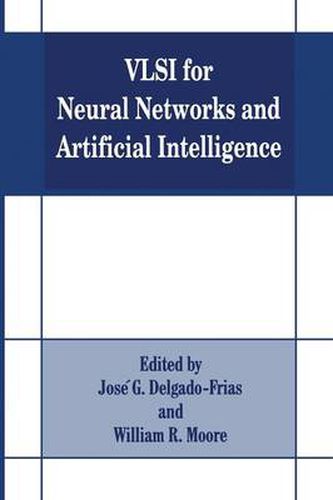
Neural network and artificial intelligence algorithrns and computing have increased not only in complexity but also in the number of applications. This in turn has posed a tremendous need for a larger computational power that conventional scalar processors may not be able to deliver efficiently. These processors are oriented towards numeric and data manipulations. Due to the neurocomputing requirements (such as non-programming and learning) and the artificial intelligence requirements (such as symbolic manipulation and knowledge representation) a different set of constraints and demands are imposed on the computer architectures/organizations for these applications. Research and development of new computer architectures and VLSI circuits for neural networks and artificial intelligence have been increased in order to meet the new performance requirements. This book presents novel approaches and trends on VLSI implementations of machines for these applications. Papers have been drawn from a number of research communities; the subjects span analog and digital VLSI design, computer design, computer architectures, neurocomputing and artificial intelligence techniques. This book has been organized into four subject areas that cover the two major categories of this book; the areas are: analog circuits for neural networks, digital implementations of neural networks, neural networks on multiprocessor systems and applications, and VLSI machines for artificial intelligence. The topics that are covered in each area are briefly introduced below.
$9.00 standard shipping within Australia
FREE standard shipping within Australia for orders over $100.00
Express & International shipping calculated at checkout
Stock availability can be subject to change without notice. We recommend calling the shop or contacting our online team to check availability of low stock items. Please see our Shopping Online page for more details.
This title is printed to order. This book may have been self-published. If so, we cannot guarantee the quality of the content. In the main most books will have gone through the editing process however some may not. We therefore suggest that you be aware of this before ordering this book. If in doubt check either the author or publisher’s details as we are unable to accept any returns unless they are faulty. Please contact us if you have any questions.
Neural network and artificial intelligence algorithrns and computing have increased not only in complexity but also in the number of applications. This in turn has posed a tremendous need for a larger computational power that conventional scalar processors may not be able to deliver efficiently. These processors are oriented towards numeric and data manipulations. Due to the neurocomputing requirements (such as non-programming and learning) and the artificial intelligence requirements (such as symbolic manipulation and knowledge representation) a different set of constraints and demands are imposed on the computer architectures/organizations for these applications. Research and development of new computer architectures and VLSI circuits for neural networks and artificial intelligence have been increased in order to meet the new performance requirements. This book presents novel approaches and trends on VLSI implementations of machines for these applications. Papers have been drawn from a number of research communities; the subjects span analog and digital VLSI design, computer design, computer architectures, neurocomputing and artificial intelligence techniques. This book has been organized into four subject areas that cover the two major categories of this book; the areas are: analog circuits for neural networks, digital implementations of neural networks, neural networks on multiprocessor systems and applications, and VLSI machines for artificial intelligence. The topics that are covered in each area are briefly introduced below.
Search our extensive online catalogue.
