Readings Newsletter
Become a Readings Member to make your shopping experience even easier.
Sign in or sign up for free!
You’re not far away from qualifying for FREE standard shipping within Australia
You’ve qualified for FREE standard shipping within Australia
The cart is loading…


This title is printed to order. This book may have been self-published. If so, we cannot guarantee the quality of the content. In the main most books will have gone through the editing process however some may not. We therefore suggest that you be aware of this before ordering this book. If in doubt check either the author or publisher’s details as we are unable to accept any returns unless they are faulty. Please contact us if you have any questions.
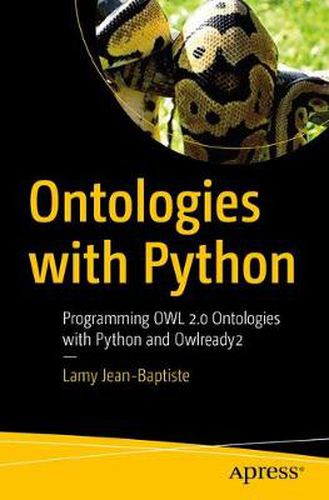
Use ontologies in Python, with the Owlready2 module developed for ontology-oriented programming. You will start with an introduction and refresher on Python and OWL ontologies. Then, you will dive straight into how to access, create, and modify ontologies in Python. Next, you will move on to an overview of semantic constructs and class properties followed by how to perform automatic reasoning. You will also learn about annotations, multilingual texts, and how to add Python methods to OWL classes and ontologies. Using medical terminologies as well as direct access to RDF triples is also covered.
Python is one of the most used programming languages, especially in the biomedical field, and formal ontologies are also widely used. However, there are limited resources for the use of ontologies in Python. Owlready2, downloaded more than 60,000 times, is a response to this problem, and this book is the first one on the topic of using ontologies with Python.
What You Will Learn
Use Owlready2 to access and modify OWL ontologies in Python Publish ontologies on dynamic websites Perform automatic reasoning in Python Use well-known ontologies, including DBpedia and Gene Ontology, and terminological resources, such as UMLS (Unified Medical Language System) Integrate Python methods in OWL ontologies
Who Is This Book For
Beginner to experienced readers from biomedical sciences and artificial intelligence fields would find the book useful.
$9.00 standard shipping within Australia
FREE standard shipping within Australia for orders over $100.00
Express & International shipping calculated at checkout
Stock availability can be subject to change without notice. We recommend calling the shop or contacting our online team to check availability of low stock items. Please see our Shopping Online page for more details.
This title is printed to order. This book may have been self-published. If so, we cannot guarantee the quality of the content. In the main most books will have gone through the editing process however some may not. We therefore suggest that you be aware of this before ordering this book. If in doubt check either the author or publisher’s details as we are unable to accept any returns unless they are faulty. Please contact us if you have any questions.
Use ontologies in Python, with the Owlready2 module developed for ontology-oriented programming. You will start with an introduction and refresher on Python and OWL ontologies. Then, you will dive straight into how to access, create, and modify ontologies in Python. Next, you will move on to an overview of semantic constructs and class properties followed by how to perform automatic reasoning. You will also learn about annotations, multilingual texts, and how to add Python methods to OWL classes and ontologies. Using medical terminologies as well as direct access to RDF triples is also covered.
Python is one of the most used programming languages, especially in the biomedical field, and formal ontologies are also widely used. However, there are limited resources for the use of ontologies in Python. Owlready2, downloaded more than 60,000 times, is a response to this problem, and this book is the first one on the topic of using ontologies with Python.
What You Will Learn
Use Owlready2 to access and modify OWL ontologies in Python Publish ontologies on dynamic websites Perform automatic reasoning in Python Use well-known ontologies, including DBpedia and Gene Ontology, and terminological resources, such as UMLS (Unified Medical Language System) Integrate Python methods in OWL ontologies
Who Is This Book For
Beginner to experienced readers from biomedical sciences and artificial intelligence fields would find the book useful.
Search our extensive online catalogue.
