Readings Newsletter
Become a Readings Member to make your shopping experience even easier.
Sign in or sign up for free!
You’re not far away from qualifying for FREE standard shipping within Australia
You’ve qualified for FREE standard shipping within Australia
The cart is loading…


This title is printed to order. This book may have been self-published. If so, we cannot guarantee the quality of the content. In the main most books will have gone through the editing process however some may not. We therefore suggest that you be aware of this before ordering this book. If in doubt check either the author or publisher’s details as we are unable to accept any returns unless they are faulty. Please contact us if you have any questions.
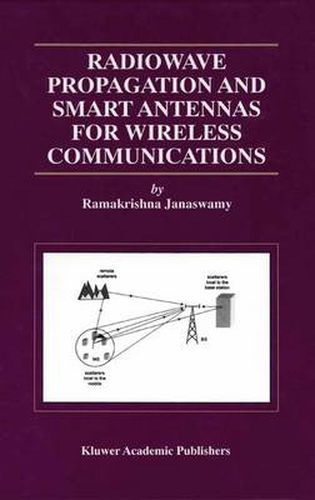
This book emerged from teaching a graduate level course in propagation and smart antennas at the Naval Postgraduate School. In its present form, it is suitable not only as a graduate level text, but also as a reference book for industry and research use. The area of radiowave propagation and smart antennas is highly interdisciplinary, extracting material from electromagn- ics, communications, and signal processing. This book is useful to workers in electromagnetics who would like to supplement their background with relevant communicational aspects and to workers in communications who would like to supplement their background with relevant electromagnetic aspects. Anyone with a basic understanding of probability, wave propagation, digital com- nications, and elementary signal processing should be able to appreciate the contents of the book. The book consists of nine chapters with several worked out examples d- persed throughout. Chapter 1 covers the basics of cellular communications. Chapter 2 covers the basic principles of electromagnetic wave propagation relevant to path loss predictions in wireless communications. Students with little prior background in electromagnetics should find the first few sections of Chapter 2 self-sufficient. Empirical path loss models that are used in system design are treated in Chapter 3. The chapter includes the traditional models as well as some of the newer models. Chapter 4 has a thorough discussion on the causes and characterization of small scale fading. The topic of spatial c- relation that is very important for antenna arrays is discussed there in detail.
$9.00 standard shipping within Australia
FREE standard shipping within Australia for orders over $100.00
Express & International shipping calculated at checkout
Stock availability can be subject to change without notice. We recommend calling the shop or contacting our online team to check availability of low stock items. Please see our Shopping Online page for more details.
This title is printed to order. This book may have been self-published. If so, we cannot guarantee the quality of the content. In the main most books will have gone through the editing process however some may not. We therefore suggest that you be aware of this before ordering this book. If in doubt check either the author or publisher’s details as we are unable to accept any returns unless they are faulty. Please contact us if you have any questions.
This book emerged from teaching a graduate level course in propagation and smart antennas at the Naval Postgraduate School. In its present form, it is suitable not only as a graduate level text, but also as a reference book for industry and research use. The area of radiowave propagation and smart antennas is highly interdisciplinary, extracting material from electromagn- ics, communications, and signal processing. This book is useful to workers in electromagnetics who would like to supplement their background with relevant communicational aspects and to workers in communications who would like to supplement their background with relevant electromagnetic aspects. Anyone with a basic understanding of probability, wave propagation, digital com- nications, and elementary signal processing should be able to appreciate the contents of the book. The book consists of nine chapters with several worked out examples d- persed throughout. Chapter 1 covers the basics of cellular communications. Chapter 2 covers the basic principles of electromagnetic wave propagation relevant to path loss predictions in wireless communications. Students with little prior background in electromagnetics should find the first few sections of Chapter 2 self-sufficient. Empirical path loss models that are used in system design are treated in Chapter 3. The chapter includes the traditional models as well as some of the newer models. Chapter 4 has a thorough discussion on the causes and characterization of small scale fading. The topic of spatial c- relation that is very important for antenna arrays is discussed there in detail.
Search our extensive online catalogue.
