Readings Newsletter
Become a Readings Member to make your shopping experience even easier.
Sign in or sign up for free!
You’re not far away from qualifying for FREE standard shipping within Australia
You’ve qualified for FREE standard shipping within Australia
The cart is loading…


This title is printed to order. This book may have been self-published. If so, we cannot guarantee the quality of the content. In the main most books will have gone through the editing process however some may not. We therefore suggest that you be aware of this before ordering this book. If in doubt check either the author or publisher’s details as we are unable to accept any returns unless they are faulty. Please contact us if you have any questions.
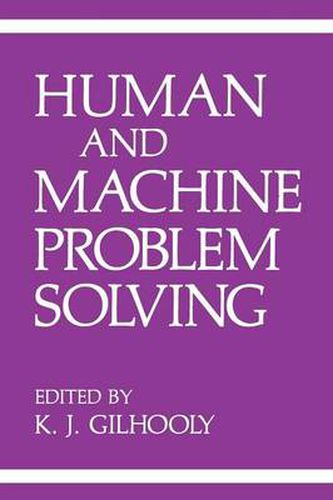
Problem solving is a central topic for both cognitive psychology and artificial intelligence (AI). Psychology seeks to analyze naturally occur ring problem solving into hypothetical processes, while AI seeks to synthesize problem-solving performance from well-defined processes. Psychology may suggest possible processes to AI and, in turn, AI may suggest plausible hypotheses to psychology. It should be useful for both sides to have some idea of the other’s contribution-hence this book, which brings together overviews of psychological and AI re search in major areas of problem solving. At a more general level, this book is intended to be a contribution toward comparative cognitive science. Cognitive science is the study of intelligent systems, whether natural or artificial, and treats both organ isms and computers as types of information-processing systems. Clearly, humans and typical current computers have rather different functional or cognitive architectures. Thus, insights into the role of cognitive ar chitecture in performance may be gained by comparing typical human problem solving with efficient machine problem solving over a range of tasks. Readers may notice that there is little mention of connectionist ap proaches in this volume. This is because, at the time of writing, such approaches have had little or no impact on research at the problem solving level. Should a similar volume be produced in ten years or so, of course, a very different story may need to be told.
$9.00 standard shipping within Australia
FREE standard shipping within Australia for orders over $100.00
Express & International shipping calculated at checkout
Stock availability can be subject to change without notice. We recommend calling the shop or contacting our online team to check availability of low stock items. Please see our Shopping Online page for more details.
This title is printed to order. This book may have been self-published. If so, we cannot guarantee the quality of the content. In the main most books will have gone through the editing process however some may not. We therefore suggest that you be aware of this before ordering this book. If in doubt check either the author or publisher’s details as we are unable to accept any returns unless they are faulty. Please contact us if you have any questions.
Problem solving is a central topic for both cognitive psychology and artificial intelligence (AI). Psychology seeks to analyze naturally occur ring problem solving into hypothetical processes, while AI seeks to synthesize problem-solving performance from well-defined processes. Psychology may suggest possible processes to AI and, in turn, AI may suggest plausible hypotheses to psychology. It should be useful for both sides to have some idea of the other’s contribution-hence this book, which brings together overviews of psychological and AI re search in major areas of problem solving. At a more general level, this book is intended to be a contribution toward comparative cognitive science. Cognitive science is the study of intelligent systems, whether natural or artificial, and treats both organ isms and computers as types of information-processing systems. Clearly, humans and typical current computers have rather different functional or cognitive architectures. Thus, insights into the role of cognitive ar chitecture in performance may be gained by comparing typical human problem solving with efficient machine problem solving over a range of tasks. Readers may notice that there is little mention of connectionist ap proaches in this volume. This is because, at the time of writing, such approaches have had little or no impact on research at the problem solving level. Should a similar volume be produced in ten years or so, of course, a very different story may need to be told.
Search our extensive online catalogue.
