Readings Newsletter
Become a Readings Member to make your shopping experience even easier.
Sign in or sign up for free!
You’re not far away from qualifying for FREE standard shipping within Australia
You’ve qualified for FREE standard shipping within Australia
The cart is loading…


This title is printed to order. This book may have been self-published. If so, we cannot guarantee the quality of the content. In the main most books will have gone through the editing process however some may not. We therefore suggest that you be aware of this before ordering this book. If in doubt check either the author or publisher’s details as we are unable to accept any returns unless they are faulty. Please contact us if you have any questions.
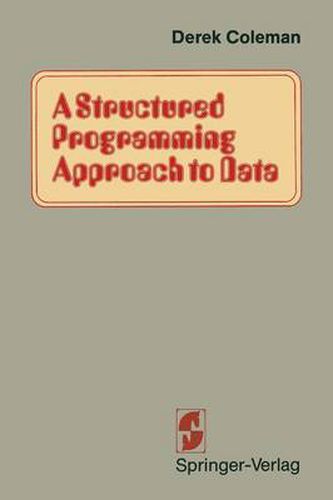
Much of current programming practice is basically empirical and ad hoc in approach. Each problem is tackled without relation to those that have gone before; experiences are made and stored as a series of fragments. Now, under the pressure of events, this unsatisfactory state of affairs is coming to an end. Programming is becoming a technology, a theory known as structured programming is developing. The purpose of a theory is to categorise and explain existing practice, thus enabling it to be improved through the development of new and sharper techniques. The resulting experiences have then to be fed back into the theory so that the process of enrichment may continue. This dialectical relationship between theory and practice is essential to a healthy programming technology. The lack of such a relationship in the 1950s and 60s and the accompanying software crisis certainly confirm the converse of this proposition. My aim in writing this book has been to explain the current state of the theory of structured programming, so that it may be used to improve the reader’s practice. The book deals with two facets of programming - how to design a program in terms of abstract data structures and how to represent the data structures on real and bounded computers. The separation between program design and data structure representation leads to more reliable and flexible programs.
$9.00 standard shipping within Australia
FREE standard shipping within Australia for orders over $100.00
Express & International shipping calculated at checkout
Stock availability can be subject to change without notice. We recommend calling the shop or contacting our online team to check availability of low stock items. Please see our Shopping Online page for more details.
This title is printed to order. This book may have been self-published. If so, we cannot guarantee the quality of the content. In the main most books will have gone through the editing process however some may not. We therefore suggest that you be aware of this before ordering this book. If in doubt check either the author or publisher’s details as we are unable to accept any returns unless they are faulty. Please contact us if you have any questions.
Much of current programming practice is basically empirical and ad hoc in approach. Each problem is tackled without relation to those that have gone before; experiences are made and stored as a series of fragments. Now, under the pressure of events, this unsatisfactory state of affairs is coming to an end. Programming is becoming a technology, a theory known as structured programming is developing. The purpose of a theory is to categorise and explain existing practice, thus enabling it to be improved through the development of new and sharper techniques. The resulting experiences have then to be fed back into the theory so that the process of enrichment may continue. This dialectical relationship between theory and practice is essential to a healthy programming technology. The lack of such a relationship in the 1950s and 60s and the accompanying software crisis certainly confirm the converse of this proposition. My aim in writing this book has been to explain the current state of the theory of structured programming, so that it may be used to improve the reader’s practice. The book deals with two facets of programming - how to design a program in terms of abstract data structures and how to represent the data structures on real and bounded computers. The separation between program design and data structure representation leads to more reliable and flexible programs.
Search our extensive online catalogue.
