Readings Newsletter
Become a Readings Member to make your shopping experience even easier.
Sign in or sign up for free!
You’re not far away from qualifying for FREE standard shipping within Australia
You’ve qualified for FREE standard shipping within Australia
The cart is loading…


This title is printed to order. This book may have been self-published. If so, we cannot guarantee the quality of the content. In the main most books will have gone through the editing process however some may not. We therefore suggest that you be aware of this before ordering this book. If in doubt check either the author or publisher’s details as we are unable to accept any returns unless they are faulty. Please contact us if you have any questions.
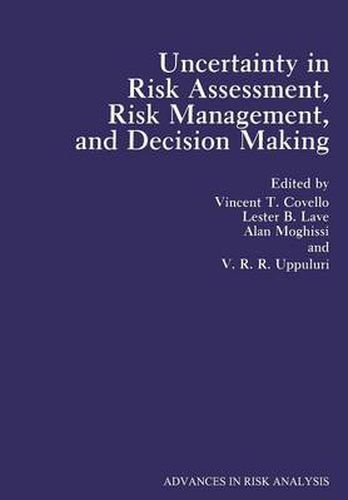
The subject of this volume–uncertainties in risk assessment and management–reflects an important theme in health, safety, and environ mental decision making. MOst technological hazards are characterized by substantial uncertainty. Recent examples include nuclear waste disposal, acid rain, asbestos in schools, carcinogens in food, and hazardous waste. realing with such uncertainty is arguably the most difficult and challeng ing task facing risk assessors and managers today. Four primary sources of uncertainty in risk assessment and management can be identified: (1) uncertainties about definitions; (2) uncertainties about scientific facts; (3) uncertainties about risk perceptions and atti tudes; and (4) uncertainties about values. Uncertainties about definitions derive primarily from disagreements about the meaning and interpretation of key concepts, such as probability. Uncertainties about scientific facts derive primarily from disagreements about failure modes, the probability and magnitude of adverse health or environmental consequences, cause and effect relationships, dose-response relationships, and exposure patterns. Uncertainties about risk perceptions and attitudes derive primarily from disagreements about what constitutes a significant or acceptable level of risk. Uncertainties about values derive primarily from disagreements about the desirability or worth of alternative risk management actions or conse quences. The papers in this volume address each of these sources of uncertainty from a variety of perspectives. Reflecting the broad scope of risk assess ment and risk management research, the papers include contributions from safety engineers, epidemiologists, toxicologists, chemists, biostatisticians, biologists, decision analysts, economists, psychologists, political scien tists, sociologists, ethicists, and lawyers.
$9.00 standard shipping within Australia
FREE standard shipping within Australia for orders over $100.00
Express & International shipping calculated at checkout
Stock availability can be subject to change without notice. We recommend calling the shop or contacting our online team to check availability of low stock items. Please see our Shopping Online page for more details.
This title is printed to order. This book may have been self-published. If so, we cannot guarantee the quality of the content. In the main most books will have gone through the editing process however some may not. We therefore suggest that you be aware of this before ordering this book. If in doubt check either the author or publisher’s details as we are unable to accept any returns unless they are faulty. Please contact us if you have any questions.
The subject of this volume–uncertainties in risk assessment and management–reflects an important theme in health, safety, and environ mental decision making. MOst technological hazards are characterized by substantial uncertainty. Recent examples include nuclear waste disposal, acid rain, asbestos in schools, carcinogens in food, and hazardous waste. realing with such uncertainty is arguably the most difficult and challeng ing task facing risk assessors and managers today. Four primary sources of uncertainty in risk assessment and management can be identified: (1) uncertainties about definitions; (2) uncertainties about scientific facts; (3) uncertainties about risk perceptions and atti tudes; and (4) uncertainties about values. Uncertainties about definitions derive primarily from disagreements about the meaning and interpretation of key concepts, such as probability. Uncertainties about scientific facts derive primarily from disagreements about failure modes, the probability and magnitude of adverse health or environmental consequences, cause and effect relationships, dose-response relationships, and exposure patterns. Uncertainties about risk perceptions and attitudes derive primarily from disagreements about what constitutes a significant or acceptable level of risk. Uncertainties about values derive primarily from disagreements about the desirability or worth of alternative risk management actions or conse quences. The papers in this volume address each of these sources of uncertainty from a variety of perspectives. Reflecting the broad scope of risk assess ment and risk management research, the papers include contributions from safety engineers, epidemiologists, toxicologists, chemists, biostatisticians, biologists, decision analysts, economists, psychologists, political scien tists, sociologists, ethicists, and lawyers.
Search our extensive online catalogue.
