Readings Newsletter
Become a Readings Member to make your shopping experience even easier.
Sign in or sign up for free!
You’re not far away from qualifying for FREE standard shipping within Australia
You’ve qualified for FREE standard shipping within Australia
The cart is loading…


This title is printed to order. This book may have been self-published. If so, we cannot guarantee the quality of the content. In the main most books will have gone through the editing process however some may not. We therefore suggest that you be aware of this before ordering this book. If in doubt check either the author or publisher’s details as we are unable to accept any returns unless they are faulty. Please contact us if you have any questions.
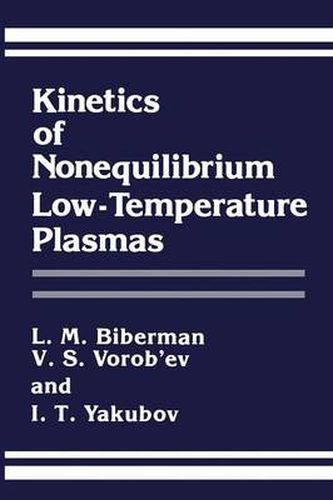
The first research on plasma was done in connection with the study of electrical discharges in gases. The focus of attention for physicists was the partially ionized plasma, the kinetics of which is governed by various collisional and radiative processes. The choice of this area of research was motivated largely by the practical problems of that time the creation of gas-discharge light sources, rectifiers, and inverters. Since the early 1950s interest in plasma physics has risen sharply, particularly in the study of the completely ionized plasma with its various collective phenomena, insta bilities, and the interesting and sometimes unexpected effects attending the propagation of electromagnetic waves in such a plasma and the action on it of external electric and magnetic fields. Interest in hot plasmas has been stimulated not only by the diverse and novel physical phenomena, but also by the problems arising in connection with controlled nuclear fusion. The advent, in the early 1960s, of new technical fields such as gas-discharge lasers, magnetohydrodynamic generators, thermoemission converters, plasma chemistry, plasma propul sion devices, various methods in plasma technology, etc. , has led to increased interest in weakly ionized low-tempera ture plasmas. This is particularly true of nonequilibrium plasmas, which are characterized by an extraordinary diver sity of states and properties.
$9.00 standard shipping within Australia
FREE standard shipping within Australia for orders over $100.00
Express & International shipping calculated at checkout
Stock availability can be subject to change without notice. We recommend calling the shop or contacting our online team to check availability of low stock items. Please see our Shopping Online page for more details.
This title is printed to order. This book may have been self-published. If so, we cannot guarantee the quality of the content. In the main most books will have gone through the editing process however some may not. We therefore suggest that you be aware of this before ordering this book. If in doubt check either the author or publisher’s details as we are unable to accept any returns unless they are faulty. Please contact us if you have any questions.
The first research on plasma was done in connection with the study of electrical discharges in gases. The focus of attention for physicists was the partially ionized plasma, the kinetics of which is governed by various collisional and radiative processes. The choice of this area of research was motivated largely by the practical problems of that time the creation of gas-discharge light sources, rectifiers, and inverters. Since the early 1950s interest in plasma physics has risen sharply, particularly in the study of the completely ionized plasma with its various collective phenomena, insta bilities, and the interesting and sometimes unexpected effects attending the propagation of electromagnetic waves in such a plasma and the action on it of external electric and magnetic fields. Interest in hot plasmas has been stimulated not only by the diverse and novel physical phenomena, but also by the problems arising in connection with controlled nuclear fusion. The advent, in the early 1960s, of new technical fields such as gas-discharge lasers, magnetohydrodynamic generators, thermoemission converters, plasma chemistry, plasma propul sion devices, various methods in plasma technology, etc. , has led to increased interest in weakly ionized low-tempera ture plasmas. This is particularly true of nonequilibrium plasmas, which are characterized by an extraordinary diver sity of states and properties.
Search our extensive online catalogue.
