Readings Newsletter
Become a Readings Member to make your shopping experience even easier.
Sign in or sign up for free!
You’re not far away from qualifying for FREE standard shipping within Australia
You’ve qualified for FREE standard shipping within Australia
The cart is loading…


This title is printed to order. This book may have been self-published. If so, we cannot guarantee the quality of the content. In the main most books will have gone through the editing process however some may not. We therefore suggest that you be aware of this before ordering this book. If in doubt check either the author or publisher’s details as we are unable to accept any returns unless they are faulty. Please contact us if you have any questions.
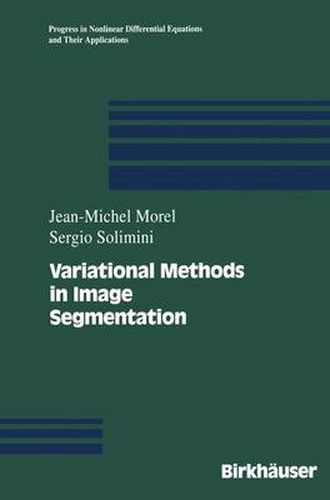
This book contains both a synthesis and mathematical analysis of a wide set of algorithms and theories whose aim is the automatic segmen tation of digital images as well as the understanding of visual perception. A common formalism for these theories and algorithms is obtained in a variational form. Thank to this formalization, mathematical questions about the soundness of algorithms can be raised and answered. Perception theory has to deal with the complex interaction between regions and edges (or boundaries) in an image: in the variational seg mentation energies, edge terms compete with region terms in a way which is supposed to impose regularity on both regions and boundaries. This fact was an experimental guess in perception phenomenology and computer vision until it was proposed as a mathematical conjecture by Mumford and Shah. The third part of the book presents a unified presentation of the evi dences in favour of the conjecture. It is proved that the competition of one-dimensional and two-dimensional energy terms in a variational for mulation cannot create fractal-like behaviour for the edges. The proof of regularity for the edges of a segmentation constantly involves con cepts from geometric measure theory, which proves to be central in im age processing theory. The second part of the book provides a fast and self-contained presentation of the classical theory of rectifiable sets (the edges ) and unrectifiable sets ( fractals ).
$9.00 standard shipping within Australia
FREE standard shipping within Australia for orders over $100.00
Express & International shipping calculated at checkout
Stock availability can be subject to change without notice. We recommend calling the shop or contacting our online team to check availability of low stock items. Please see our Shopping Online page for more details.
This title is printed to order. This book may have been self-published. If so, we cannot guarantee the quality of the content. In the main most books will have gone through the editing process however some may not. We therefore suggest that you be aware of this before ordering this book. If in doubt check either the author or publisher’s details as we are unable to accept any returns unless they are faulty. Please contact us if you have any questions.
This book contains both a synthesis and mathematical analysis of a wide set of algorithms and theories whose aim is the automatic segmen tation of digital images as well as the understanding of visual perception. A common formalism for these theories and algorithms is obtained in a variational form. Thank to this formalization, mathematical questions about the soundness of algorithms can be raised and answered. Perception theory has to deal with the complex interaction between regions and edges (or boundaries) in an image: in the variational seg mentation energies, edge terms compete with region terms in a way which is supposed to impose regularity on both regions and boundaries. This fact was an experimental guess in perception phenomenology and computer vision until it was proposed as a mathematical conjecture by Mumford and Shah. The third part of the book presents a unified presentation of the evi dences in favour of the conjecture. It is proved that the competition of one-dimensional and two-dimensional energy terms in a variational for mulation cannot create fractal-like behaviour for the edges. The proof of regularity for the edges of a segmentation constantly involves con cepts from geometric measure theory, which proves to be central in im age processing theory. The second part of the book provides a fast and self-contained presentation of the classical theory of rectifiable sets (the edges ) and unrectifiable sets ( fractals ).
Search our extensive online catalogue.
