Readings Newsletter
Become a Readings Member to make your shopping experience even easier.
Sign in or sign up for free!
You’re not far away from qualifying for FREE standard shipping within Australia
You’ve qualified for FREE standard shipping within Australia
The cart is loading…


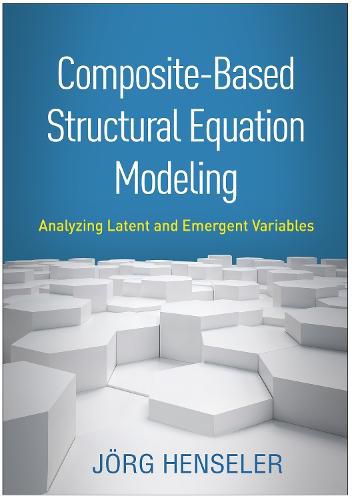
This book presents powerful tools for integrating interrelated composites–such as capabilities, policies, treatments, indices, and systems–into structural equation modeling (SEM). Joerg Henseler introduces the types of research questions that can be addressed with composite-based SEM and explores the differences between composite- and factor-based SEM, variance- and covariance-based SEM, and emergent and latent variables. Using rich illustrations and walked-through data sets, the book covers how to specify, identify, estimate, and assess composite models using partial least squares path modeling, maximum likelihood, and other estimators, as well as how to interpret findings and report the results. Advanced topics include confirmatory composite analysis, mediation analysis, second-order constructs, interaction effects, and importance-performance analysis. Most chapters conclude with software tutorials for ADANCO and the R package cSEM. The companion website includes data files and syntax for the book’s examples, along with presentation slides.
$9.00 standard shipping within Australia
FREE standard shipping within Australia for orders over $100.00
Express & International shipping calculated at checkout
Stock availability can be subject to change without notice. We recommend calling the shop or contacting our online team to check availability of low stock items. Please see our Shopping Online page for more details.
This book presents powerful tools for integrating interrelated composites–such as capabilities, policies, treatments, indices, and systems–into structural equation modeling (SEM). Joerg Henseler introduces the types of research questions that can be addressed with composite-based SEM and explores the differences between composite- and factor-based SEM, variance- and covariance-based SEM, and emergent and latent variables. Using rich illustrations and walked-through data sets, the book covers how to specify, identify, estimate, and assess composite models using partial least squares path modeling, maximum likelihood, and other estimators, as well as how to interpret findings and report the results. Advanced topics include confirmatory composite analysis, mediation analysis, second-order constructs, interaction effects, and importance-performance analysis. Most chapters conclude with software tutorials for ADANCO and the R package cSEM. The companion website includes data files and syntax for the book’s examples, along with presentation slides.
Search our extensive online catalogue.
