Readings Newsletter
Become a Readings Member to make your shopping experience even easier.
Sign in or sign up for free!
You’re not far away from qualifying for FREE standard shipping within Australia
You’ve qualified for FREE standard shipping within Australia
The cart is loading…


This title is printed to order. This book may have been self-published. If so, we cannot guarantee the quality of the content. In the main most books will have gone through the editing process however some may not. We therefore suggest that you be aware of this before ordering this book. If in doubt check either the author or publisher’s details as we are unable to accept any returns unless they are faulty. Please contact us if you have any questions.
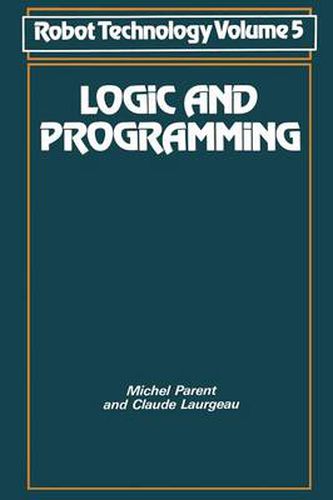
In contrast to the effortless ease with which human beings control their limbs, the design of controllers for robotic manipulator arms is a detailed, meticulous business. Motors controlling the arms need to be started and stopped at just the right moment so that the performance demanded by the user may be achieved at the end of a complicated manoeuvre. And yet, the same user wishes to express the task for the robot in the simplest possible terms without reference to the minute details of control sequences that his task demands. It is the design of such inter faces between man and machine that is the subject of trus volume. Parent and Laurgeau develop the subject in a direct and logical order. They first explain the principles of maximal effort control which not only ensure that motors are driven to provide high accuracy, but also that this should be done with the least waste of energy and in the shortest possible time. In this context, they describe the operation of pneumatic logical devices that make rapid decisions at power levels that exceed, by several orders, those that can be achieved with electronic devices. They achieve this whilst keeping the reader aware of the logical principles that are involved in the design of master control units: the devices responsible for appropriate actions being taken as a function of time.
$9.00 standard shipping within Australia
FREE standard shipping within Australia for orders over $100.00
Express & International shipping calculated at checkout
Stock availability can be subject to change without notice. We recommend calling the shop or contacting our online team to check availability of low stock items. Please see our Shopping Online page for more details.
This title is printed to order. This book may have been self-published. If so, we cannot guarantee the quality of the content. In the main most books will have gone through the editing process however some may not. We therefore suggest that you be aware of this before ordering this book. If in doubt check either the author or publisher’s details as we are unable to accept any returns unless they are faulty. Please contact us if you have any questions.
In contrast to the effortless ease with which human beings control their limbs, the design of controllers for robotic manipulator arms is a detailed, meticulous business. Motors controlling the arms need to be started and stopped at just the right moment so that the performance demanded by the user may be achieved at the end of a complicated manoeuvre. And yet, the same user wishes to express the task for the robot in the simplest possible terms without reference to the minute details of control sequences that his task demands. It is the design of such inter faces between man and machine that is the subject of trus volume. Parent and Laurgeau develop the subject in a direct and logical order. They first explain the principles of maximal effort control which not only ensure that motors are driven to provide high accuracy, but also that this should be done with the least waste of energy and in the shortest possible time. In this context, they describe the operation of pneumatic logical devices that make rapid decisions at power levels that exceed, by several orders, those that can be achieved with electronic devices. They achieve this whilst keeping the reader aware of the logical principles that are involved in the design of master control units: the devices responsible for appropriate actions being taken as a function of time.
Search our extensive online catalogue.
