Readings Newsletter
Become a Readings Member to make your shopping experience even easier.
Sign in or sign up for free!
You’re not far away from qualifying for FREE standard shipping within Australia
You’ve qualified for FREE standard shipping within Australia
The cart is loading…


This title is printed to order. This book may have been self-published. If so, we cannot guarantee the quality of the content. In the main most books will have gone through the editing process however some may not. We therefore suggest that you be aware of this before ordering this book. If in doubt check either the author or publisher’s details as we are unable to accept any returns unless they are faulty. Please contact us if you have any questions.
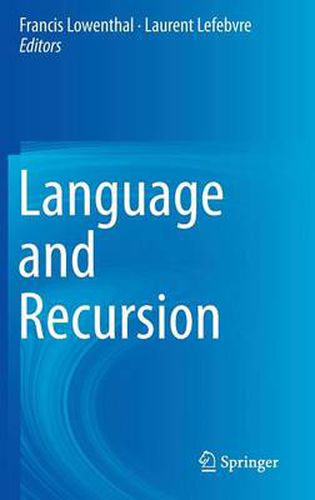
As humans, our many levels of language use distinguish us from the rest of the animal world. For many scholars, it is the recursive aspect of human speech that makes it truly human. But linguists continue to argue about what recursion actually is, leading to the central dilemma: is full recursion, as defined by mathematicians, really necessary for human language? Language and Recursion defines the elusive construct with the goal of furthering research into language and cognition. An up-to-date literature review surveys extensive findings based on non-verbal communication devices and neuroimaging techniques. Comparing human and non-human primate communication, the book’s contributors examine meaning in chimpanzee calls, and consider the possibility of a specific brain structure for recursion. The implications are then extended to formal grammars associated with artificial intelligence, and to the question of whether recursion is a valid concept at all. Among the topics covered: * The pragmatic origins of recursion. * Recursive cognition as a prelude to language. * Computer simulations of recursive exercises for a non-verbal communication device. * Early rule learning ability and language acquisition. * Computational language related to recursion, incursion, and fractals * Why there may be no recursion in language. Regardless of where one stands in the debate, Language and Recursion has much to offer the science community, particularly cognitive psychologists and researchers in the science of language. By presenting these multiple viewpoints, the book makes a solid case for eventual reconciliation.
$9.00 standard shipping within Australia
FREE standard shipping within Australia for orders over $100.00
Express & International shipping calculated at checkout
Stock availability can be subject to change without notice. We recommend calling the shop or contacting our online team to check availability of low stock items. Please see our Shopping Online page for more details.
This title is printed to order. This book may have been self-published. If so, we cannot guarantee the quality of the content. In the main most books will have gone through the editing process however some may not. We therefore suggest that you be aware of this before ordering this book. If in doubt check either the author or publisher’s details as we are unable to accept any returns unless they are faulty. Please contact us if you have any questions.
As humans, our many levels of language use distinguish us from the rest of the animal world. For many scholars, it is the recursive aspect of human speech that makes it truly human. But linguists continue to argue about what recursion actually is, leading to the central dilemma: is full recursion, as defined by mathematicians, really necessary for human language? Language and Recursion defines the elusive construct with the goal of furthering research into language and cognition. An up-to-date literature review surveys extensive findings based on non-verbal communication devices and neuroimaging techniques. Comparing human and non-human primate communication, the book’s contributors examine meaning in chimpanzee calls, and consider the possibility of a specific brain structure for recursion. The implications are then extended to formal grammars associated with artificial intelligence, and to the question of whether recursion is a valid concept at all. Among the topics covered: * The pragmatic origins of recursion. * Recursive cognition as a prelude to language. * Computer simulations of recursive exercises for a non-verbal communication device. * Early rule learning ability and language acquisition. * Computational language related to recursion, incursion, and fractals * Why there may be no recursion in language. Regardless of where one stands in the debate, Language and Recursion has much to offer the science community, particularly cognitive psychologists and researchers in the science of language. By presenting these multiple viewpoints, the book makes a solid case for eventual reconciliation.
Search our extensive online catalogue.
