Readings Newsletter
Become a Readings Member to make your shopping experience even easier.
Sign in or sign up for free!
You’re not far away from qualifying for FREE standard shipping within Australia
You’ve qualified for FREE standard shipping within Australia
The cart is loading…


This title is printed to order. This book may have been self-published. If so, we cannot guarantee the quality of the content. In the main most books will have gone through the editing process however some may not. We therefore suggest that you be aware of this before ordering this book. If in doubt check either the author or publisher’s details as we are unable to accept any returns unless they are faulty. Please contact us if you have any questions.
Terrorist groups throughout the world have been studied primarily through the use of social science methods. However, major advances in IT during the past decade have led to significant new ways of studying terrorist groups, making forecasts, learning models of their behaviour, and shaping policies about their behaviour.
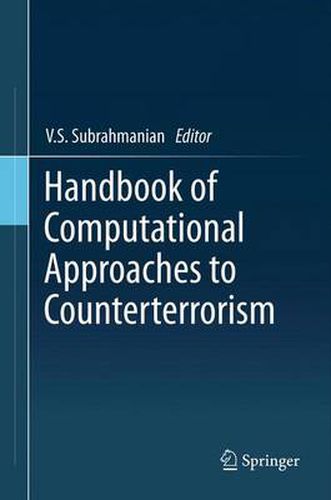
Handbook of Computational Approaches to Counterterrorism provides the first in-depth look at how advanced mathematics and modern computing technology is shaping the study of terrorist groups. This book includes contributions from world experts in the field, and presents extensive information on terrorism data sets, new ways of building such data sets in real-time using text analytics, introduces the mathematics and computational approaches to understand terror group behaviour, analyzes terror networks, forecasts terror group behaviour, and shapes policies against terrorist groups. Auxiliary information will be posted on the book’s website.
This book targets defence analysts, counter terror analysts, computer scientists, mathematicians, political scientists, psychologists, and researchers from the wide variety of fields engaged in counter-terrorism research. Advanced-level students in computer science, mathematics and social sciences will also find this book useful.
$9.00 standard shipping within Australia
FREE standard shipping within Australia for orders over $100.00
Express & International shipping calculated at checkout
Stock availability can be subject to change without notice. We recommend calling the shop or contacting our online team to check availability of low stock items. Please see our Shopping Online page for more details.
This title is printed to order. This book may have been self-published. If so, we cannot guarantee the quality of the content. In the main most books will have gone through the editing process however some may not. We therefore suggest that you be aware of this before ordering this book. If in doubt check either the author or publisher’s details as we are unable to accept any returns unless they are faulty. Please contact us if you have any questions.
Terrorist groups throughout the world have been studied primarily through the use of social science methods. However, major advances in IT during the past decade have led to significant new ways of studying terrorist groups, making forecasts, learning models of their behaviour, and shaping policies about their behaviour.
Handbook of Computational Approaches to Counterterrorism provides the first in-depth look at how advanced mathematics and modern computing technology is shaping the study of terrorist groups. This book includes contributions from world experts in the field, and presents extensive information on terrorism data sets, new ways of building such data sets in real-time using text analytics, introduces the mathematics and computational approaches to understand terror group behaviour, analyzes terror networks, forecasts terror group behaviour, and shapes policies against terrorist groups. Auxiliary information will be posted on the book’s website.
This book targets defence analysts, counter terror analysts, computer scientists, mathematicians, political scientists, psychologists, and researchers from the wide variety of fields engaged in counter-terrorism research. Advanced-level students in computer science, mathematics and social sciences will also find this book useful.
Search our extensive online catalogue.
