Readings Newsletter
Become a Readings Member to make your shopping experience even easier.
Sign in or sign up for free!
You’re not far away from qualifying for FREE standard shipping within Australia
You’ve qualified for FREE standard shipping within Australia
The cart is loading…


This title is printed to order. This book may have been self-published. If so, we cannot guarantee the quality of the content. In the main most books will have gone through the editing process however some may not. We therefore suggest that you be aware of this before ordering this book. If in doubt check either the author or publisher’s details as we are unable to accept any returns unless they are faulty. Please contact us if you have any questions.
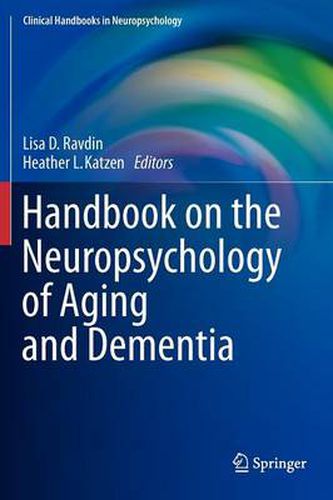
With the aging of the baby boomers and medical advances that promote longevity, older adults are rapidly becoming the fastest growing segment of the population. As the population ages, so does the incidence of age related disorders. Many predict that 15% - 20% of the baby-boomer generation will develop some form of cognitive decline over the course of their lifetime, with estimates escalating to up to 50% in those achieving advanced age. Although much attention has been directed at Alzheimer’s disease, the most common form of dementia, it is estimated that nearly one third of those cases of cognitive decline result from other neuropathological mechanisms. In fact, many patients diagnosed with Alzheimer’s disease likely have co-morbid disorders that can also influence cognition (i.e., vascular cognitive impairment), suggesting mixed dementias are grossly under diagnosed. The Clinical Handbook on the Neuropsychology of Aging and Dementia is a unique work that provides clinicians with expert guidance and a hands-on approach to neuropsychological practice with older adults. The book will be divided into two sections, the first addressing special considerations for the evaluation of older adults, and the second half focusing on common referral questions likely to be encountered when working with this age group. The authors of the chapters are experts and are recognized by their peers as opinion leaders in their chosen chapter topics. The field of neuropsychology has played a critical role in developing methods for early identification of late life cognitive disorders as well as the differential diagnosis of dementia. Neuropsychological assessment provides valuable clinical information regarding the nature and severity of cognitive symptoms associated with dementia. Each chapter will reinforce the notion that neuropsychological measures provide the clinician with sensitive tools to differentiate normal age-related cognitive decline from disease-associated impairment, aid in differential diagnosis of cognitive dysfunction in older adults, as well as identify cognitive deficits most likely to translate into functional impairments in everyday life.
$9.00 standard shipping within Australia
FREE standard shipping within Australia for orders over $100.00
Express & International shipping calculated at checkout
Stock availability can be subject to change without notice. We recommend calling the shop or contacting our online team to check availability of low stock items. Please see our Shopping Online page for more details.
This title is printed to order. This book may have been self-published. If so, we cannot guarantee the quality of the content. In the main most books will have gone through the editing process however some may not. We therefore suggest that you be aware of this before ordering this book. If in doubt check either the author or publisher’s details as we are unable to accept any returns unless they are faulty. Please contact us if you have any questions.
With the aging of the baby boomers and medical advances that promote longevity, older adults are rapidly becoming the fastest growing segment of the population. As the population ages, so does the incidence of age related disorders. Many predict that 15% - 20% of the baby-boomer generation will develop some form of cognitive decline over the course of their lifetime, with estimates escalating to up to 50% in those achieving advanced age. Although much attention has been directed at Alzheimer’s disease, the most common form of dementia, it is estimated that nearly one third of those cases of cognitive decline result from other neuropathological mechanisms. In fact, many patients diagnosed with Alzheimer’s disease likely have co-morbid disorders that can also influence cognition (i.e., vascular cognitive impairment), suggesting mixed dementias are grossly under diagnosed. The Clinical Handbook on the Neuropsychology of Aging and Dementia is a unique work that provides clinicians with expert guidance and a hands-on approach to neuropsychological practice with older adults. The book will be divided into two sections, the first addressing special considerations for the evaluation of older adults, and the second half focusing on common referral questions likely to be encountered when working with this age group. The authors of the chapters are experts and are recognized by their peers as opinion leaders in their chosen chapter topics. The field of neuropsychology has played a critical role in developing methods for early identification of late life cognitive disorders as well as the differential diagnosis of dementia. Neuropsychological assessment provides valuable clinical information regarding the nature and severity of cognitive symptoms associated with dementia. Each chapter will reinforce the notion that neuropsychological measures provide the clinician with sensitive tools to differentiate normal age-related cognitive decline from disease-associated impairment, aid in differential diagnosis of cognitive dysfunction in older adults, as well as identify cognitive deficits most likely to translate into functional impairments in everyday life.
Search our extensive online catalogue.
