Readings Newsletter
Become a Readings Member to make your shopping experience even easier.
Sign in or sign up for free!
You’re not far away from qualifying for FREE standard shipping within Australia
You’ve qualified for FREE standard shipping within Australia
The cart is loading…


This title is printed to order. This book may have been self-published. If so, we cannot guarantee the quality of the content. In the main most books will have gone through the editing process however some may not. We therefore suggest that you be aware of this before ordering this book. If in doubt check either the author or publisher’s details as we are unable to accept any returns unless they are faulty. Please contact us if you have any questions.
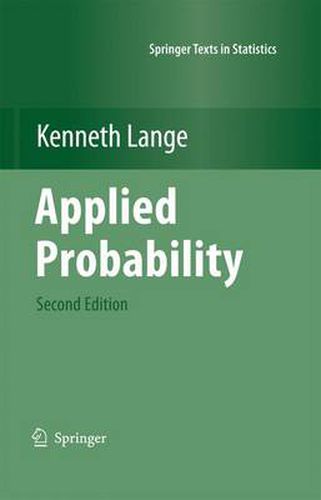
Applied Probability presents a unique blend of theory and applications, with special emphasis on mathematical modeling, computational techniques, and examples from the biological sciences. It can serve as a textbook for graduate students in applied mathematics, biostatistics, computational biology, computer science, physics, and statistics. Readers should have a working knowledge of multivariate calculus, linear algebra, ordinary differential equations, and elementary probability theory.
Chapter 1 reviews elementary probability and provides a brief survey of relevant results from measure theory. Chapter 2 is an extended essay on calculating expectations. Chapter 3 deals with probabilistic applications of convexity, inequalities, and optimization theory. Chapters 4 and 5 touch on combinatorics and combinatorial optimization. Chapters 6 through 11 present core material on stochastic processes. If supplemented with appropriate sections from Chapters 1 and 2, there is sufficient material for a traditional semester-long course in stochastic processes covering the basics of Poisson processes, Markov chains, branching processes, martingales, and diffusion processes. The second edition adds two new chapters on asymptotic and numerical methods and an appendix that separates some of the more delicate mathematical theory from the steady flow of examples in the main text.
Besides the two new chapters, the second edition includes a more extensive list of exercises, many additions to the exposition of combinatorics, new material on rates of convergence to equilibrium in reversible Markov chains, a discussion of basic reproduction numbers in population modeling, and better coverage of Brownian motion. Because many chapters are nearly self-contained, mathematical scientists from a variety of backgrounds will find Applied Probability useful as a reference
$9.00 standard shipping within Australia
FREE standard shipping within Australia for orders over $100.00
Express & International shipping calculated at checkout
Stock availability can be subject to change without notice. We recommend calling the shop or contacting our online team to check availability of low stock items. Please see our Shopping Online page for more details.
This title is printed to order. This book may have been self-published. If so, we cannot guarantee the quality of the content. In the main most books will have gone through the editing process however some may not. We therefore suggest that you be aware of this before ordering this book. If in doubt check either the author or publisher’s details as we are unable to accept any returns unless they are faulty. Please contact us if you have any questions.
Applied Probability presents a unique blend of theory and applications, with special emphasis on mathematical modeling, computational techniques, and examples from the biological sciences. It can serve as a textbook for graduate students in applied mathematics, biostatistics, computational biology, computer science, physics, and statistics. Readers should have a working knowledge of multivariate calculus, linear algebra, ordinary differential equations, and elementary probability theory.
Chapter 1 reviews elementary probability and provides a brief survey of relevant results from measure theory. Chapter 2 is an extended essay on calculating expectations. Chapter 3 deals with probabilistic applications of convexity, inequalities, and optimization theory. Chapters 4 and 5 touch on combinatorics and combinatorial optimization. Chapters 6 through 11 present core material on stochastic processes. If supplemented with appropriate sections from Chapters 1 and 2, there is sufficient material for a traditional semester-long course in stochastic processes covering the basics of Poisson processes, Markov chains, branching processes, martingales, and diffusion processes. The second edition adds two new chapters on asymptotic and numerical methods and an appendix that separates some of the more delicate mathematical theory from the steady flow of examples in the main text.
Besides the two new chapters, the second edition includes a more extensive list of exercises, many additions to the exposition of combinatorics, new material on rates of convergence to equilibrium in reversible Markov chains, a discussion of basic reproduction numbers in population modeling, and better coverage of Brownian motion. Because many chapters are nearly self-contained, mathematical scientists from a variety of backgrounds will find Applied Probability useful as a reference
Search our extensive online catalogue.
