Readings Newsletter
Become a Readings Member to make your shopping experience even easier.
Sign in or sign up for free!
You’re not far away from qualifying for FREE standard shipping within Australia
You’ve qualified for FREE standard shipping within Australia
The cart is loading…


This title is printed to order. This book may have been self-published. If so, we cannot guarantee the quality of the content. In the main most books will have gone through the editing process however some may not. We therefore suggest that you be aware of this before ordering this book. If in doubt check either the author or publisher’s details as we are unable to accept any returns unless they are faulty. Please contact us if you have any questions.
The availability of today’s online information systems rapidly increases the relevance of dynamic decision making within a large number of operational contexts. Whenever a sequence of interdependent decisions occurs, making a single decision raises the need for anticipation of its future impact on the entire decision process. Anticipatory support is needed for a broad variety of dynamic and stochastic decision problems from different operational contexts such as finance, energy management, manufacturing and transportation. Example problems include asset allocation, feed-in of electricity produced by wind power as well as scheduling and routing. All these problems entail a sequence of decisions contributing to an overall goal and taking place in the course of a certain period of time. Each of the decisions is derived by solution of an optimization problem. As a consequence a stochastic and dynamic decision problem resolves into a series of optimization problems to be formulated and solved by anticipation of the remaining decision process.
However, actually solving a dynamic decision problem by means of approximate dynamic programming still is a major scientific challenge. Most of the work done so far is devoted to problems allowing for formulation of the underlying optimization problems as linear programs. Problem domains like scheduling and routing, where linear programming typically does not produce a significant benefit for problem solving, have not been considered so far. Therefore, the industry demand for dynamic scheduling and routing is still predominantly satisfied by purely heuristic approaches to anticipatory decision making. Although this may work well for certain dynamic decision problems, these approaches lack transferability of findings to other, related problems.
This book has serves two major purposes:
It provides a comprehensive and unique view of anticipatory optimization for dynamic decision making. It fully integrates Markov decision processes, dynamic programming, data mining and optimization and introduces a new perspective on approximate dynamic programming. Moreover, the book identifies different degrees of anticipation, enabling an assessment of specific approaches to dynamic decision making.
It shows for the first time how to successfully solve a dynamic vehicle routing problem by approximate dynamic programming. It elaborates on every building block required for this kind of approach to dynamic vehicle routing. Thereby the book has a pioneering character and is intended to provide a footing for the dynamic vehicle routing community.
$9.00 standard shipping within Australia
FREE standard shipping within Australia for orders over $100.00
Express & International shipping calculated at checkout
Stock availability can be subject to change without notice. We recommend calling the shop or contacting our online team to check availability of low stock items. Please see our Shopping Online page for more details.
This title is printed to order. This book may have been self-published. If so, we cannot guarantee the quality of the content. In the main most books will have gone through the editing process however some may not. We therefore suggest that you be aware of this before ordering this book. If in doubt check either the author or publisher’s details as we are unable to accept any returns unless they are faulty. Please contact us if you have any questions.
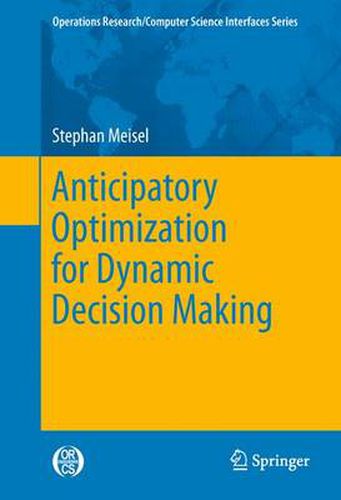
The availability of today’s online information systems rapidly increases the relevance of dynamic decision making within a large number of operational contexts. Whenever a sequence of interdependent decisions occurs, making a single decision raises the need for anticipation of its future impact on the entire decision process. Anticipatory support is needed for a broad variety of dynamic and stochastic decision problems from different operational contexts such as finance, energy management, manufacturing and transportation. Example problems include asset allocation, feed-in of electricity produced by wind power as well as scheduling and routing. All these problems entail a sequence of decisions contributing to an overall goal and taking place in the course of a certain period of time. Each of the decisions is derived by solution of an optimization problem. As a consequence a stochastic and dynamic decision problem resolves into a series of optimization problems to be formulated and solved by anticipation of the remaining decision process.
However, actually solving a dynamic decision problem by means of approximate dynamic programming still is a major scientific challenge. Most of the work done so far is devoted to problems allowing for formulation of the underlying optimization problems as linear programs. Problem domains like scheduling and routing, where linear programming typically does not produce a significant benefit for problem solving, have not been considered so far. Therefore, the industry demand for dynamic scheduling and routing is still predominantly satisfied by purely heuristic approaches to anticipatory decision making. Although this may work well for certain dynamic decision problems, these approaches lack transferability of findings to other, related problems.
This book has serves two major purposes:
It provides a comprehensive and unique view of anticipatory optimization for dynamic decision making. It fully integrates Markov decision processes, dynamic programming, data mining and optimization and introduces a new perspective on approximate dynamic programming. Moreover, the book identifies different degrees of anticipation, enabling an assessment of specific approaches to dynamic decision making.
It shows for the first time how to successfully solve a dynamic vehicle routing problem by approximate dynamic programming. It elaborates on every building block required for this kind of approach to dynamic vehicle routing. Thereby the book has a pioneering character and is intended to provide a footing for the dynamic vehicle routing community.
Search our extensive online catalogue.
