Readings Newsletter
Become a Readings Member to make your shopping experience even easier.
Sign in or sign up for free!
You’re not far away from qualifying for FREE standard shipping within Australia
You’ve qualified for FREE standard shipping within Australia
The cart is loading…


This title is printed to order. This book may have been self-published. If so, we cannot guarantee the quality of the content. In the main most books will have gone through the editing process however some may not. We therefore suggest that you be aware of this before ordering this book. If in doubt check either the author or publisher’s details as we are unable to accept any returns unless they are faulty. Please contact us if you have any questions.
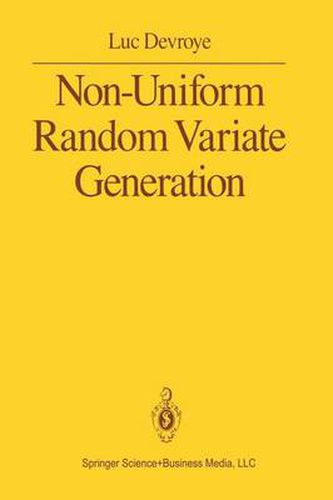
Thls text ls about one small fteld on the crossroads of statlstlcs, operatlons research and computer sclence. Statistleians need random number generators to test and compare estlmators before uslng them ln real l!fe. In operatlons research, random numbers are a key component ln !arge scale slmulatlons. Computer sclen- tlsts need randomness ln program testlng, game playlng and comparlsons of algo- rlthms. The appl!catlons are wlde and varled. Yet all depend upon the same com- puter generated random numbers. Usually, the randomness demanded by an appl!catlon has some bullt-ln structure: typlcally, one needs more than just a sequence of Independent random blts or Independent uniform [0,1] random vari- ables. Some users need random variables wlth unusual densltles, or random com- blnatorlal objects wlth speclftc propertles, or random geometrlc objects, or ran- dom processes wlth weil deftned dependence structures. Thls ls preclsely the sub- ject area of the book, the study of non-uniform random varlates. The plot evolves around the expected complexlty of random varlate genera- tlon algorlthms. We set up an ldeal!zed computatlonal model (wlthout overdolng lt), we lntroduce the notlon of unlformly bounded expected complexlty, and we study upper and lower bounds for computatlonal complexlty. In short, a touch of computer sclence ls added to the fteld. To keep everythlng abstract, no tlmlngs or computer programs are lncluded. Thls was a Iabor of Iove. George Marsagl!a created CS690, a course on ran- dom number generat!on at the School of Computer Sclence of McG!ll Unlverslty.
$9.00 standard shipping within Australia
FREE standard shipping within Australia for orders over $100.00
Express & International shipping calculated at checkout
Stock availability can be subject to change without notice. We recommend calling the shop or contacting our online team to check availability of low stock items. Please see our Shopping Online page for more details.
This title is printed to order. This book may have been self-published. If so, we cannot guarantee the quality of the content. In the main most books will have gone through the editing process however some may not. We therefore suggest that you be aware of this before ordering this book. If in doubt check either the author or publisher’s details as we are unable to accept any returns unless they are faulty. Please contact us if you have any questions.
Thls text ls about one small fteld on the crossroads of statlstlcs, operatlons research and computer sclence. Statistleians need random number generators to test and compare estlmators before uslng them ln real l!fe. In operatlons research, random numbers are a key component ln !arge scale slmulatlons. Computer sclen- tlsts need randomness ln program testlng, game playlng and comparlsons of algo- rlthms. The appl!catlons are wlde and varled. Yet all depend upon the same com- puter generated random numbers. Usually, the randomness demanded by an appl!catlon has some bullt-ln structure: typlcally, one needs more than just a sequence of Independent random blts or Independent uniform [0,1] random vari- ables. Some users need random variables wlth unusual densltles, or random com- blnatorlal objects wlth speclftc propertles, or random geometrlc objects, or ran- dom processes wlth weil deftned dependence structures. Thls ls preclsely the sub- ject area of the book, the study of non-uniform random varlates. The plot evolves around the expected complexlty of random varlate genera- tlon algorlthms. We set up an ldeal!zed computatlonal model (wlthout overdolng lt), we lntroduce the notlon of unlformly bounded expected complexlty, and we study upper and lower bounds for computatlonal complexlty. In short, a touch of computer sclence ls added to the fteld. To keep everythlng abstract, no tlmlngs or computer programs are lncluded. Thls was a Iabor of Iove. George Marsagl!a created CS690, a course on ran- dom number generat!on at the School of Computer Sclence of McG!ll Unlverslty.
Search our extensive online catalogue.
