Readings Newsletter
Become a Readings Member to make your shopping experience even easier.
Sign in or sign up for free!
You’re not far away from qualifying for FREE standard shipping within Australia
You’ve qualified for FREE standard shipping within Australia
The cart is loading…


This title is printed to order. This book may have been self-published. If so, we cannot guarantee the quality of the content. In the main most books will have gone through the editing process however some may not. We therefore suggest that you be aware of this before ordering this book. If in doubt check either the author or publisher’s details as we are unable to accept any returns unless they are faulty. Please contact us if you have any questions.
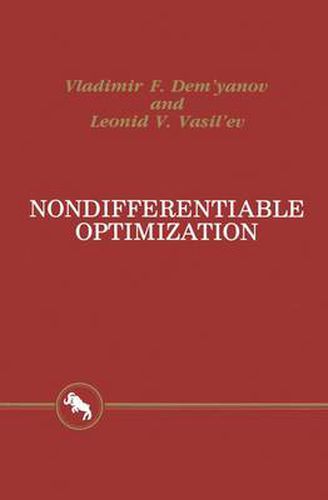
Of recent coinage, the term nondifferentiable optimization (NDO) covers a spectrum of problems related to finding extremal values of nondifferentiable functions. Problems of minimizing nonsmooth functions arise in engineering applications as well as in mathematics proper. The Chebyshev approximation problem is an ample illustration of this. Without loss of generality, we shall consider only minimization problems. Among nonsmooth minimization problems, minimax problems and convex problems have been studied extensively ([31], [36], [57], [110], [120]). Interest in NDO has been constantly growing in recent years (monographs: [30], [81], [127] and articles and papers: [14], [20], [87]-[89], [98], [130], [135], [140]-[142], [152], [153], [160], all dealing with various aspects of non smooth optimization). For solving an arbitrary minimization problem, it is neces sary to: 1. Study properties of the objective function, in particular, its differentiability and directional differentiability. 2. Establish necessary (and, if possible, sufficient) condi tions for a global or local minimum. 3. Find the direction of descent (steepest or, simply, feasible–in appropriate sense). 4. Construct methods of successive approximation. In this book, the minimization problems for nonsmooth func tions of a finite number of variables are considered. Of fun damental importance are necessary conditions for an extremum (for example, [24], [45], [57], [73], [74], [103], [159], [163], [167], [168].
$9.00 standard shipping within Australia
FREE standard shipping within Australia for orders over $100.00
Express & International shipping calculated at checkout
Stock availability can be subject to change without notice. We recommend calling the shop or contacting our online team to check availability of low stock items. Please see our Shopping Online page for more details.
This title is printed to order. This book may have been self-published. If so, we cannot guarantee the quality of the content. In the main most books will have gone through the editing process however some may not. We therefore suggest that you be aware of this before ordering this book. If in doubt check either the author or publisher’s details as we are unable to accept any returns unless they are faulty. Please contact us if you have any questions.
Of recent coinage, the term nondifferentiable optimization (NDO) covers a spectrum of problems related to finding extremal values of nondifferentiable functions. Problems of minimizing nonsmooth functions arise in engineering applications as well as in mathematics proper. The Chebyshev approximation problem is an ample illustration of this. Without loss of generality, we shall consider only minimization problems. Among nonsmooth minimization problems, minimax problems and convex problems have been studied extensively ([31], [36], [57], [110], [120]). Interest in NDO has been constantly growing in recent years (monographs: [30], [81], [127] and articles and papers: [14], [20], [87]-[89], [98], [130], [135], [140]-[142], [152], [153], [160], all dealing with various aspects of non smooth optimization). For solving an arbitrary minimization problem, it is neces sary to: 1. Study properties of the objective function, in particular, its differentiability and directional differentiability. 2. Establish necessary (and, if possible, sufficient) condi tions for a global or local minimum. 3. Find the direction of descent (steepest or, simply, feasible–in appropriate sense). 4. Construct methods of successive approximation. In this book, the minimization problems for nonsmooth func tions of a finite number of variables are considered. Of fun damental importance are necessary conditions for an extremum (for example, [24], [45], [57], [73], [74], [103], [159], [163], [167], [168].
Search our extensive online catalogue.
