Readings Newsletter
Become a Readings Member to make your shopping experience even easier.
Sign in or sign up for free!
You’re not far away from qualifying for FREE standard shipping within Australia
You’ve qualified for FREE standard shipping within Australia
The cart is loading…


This title is printed to order. This book may have been self-published. If so, we cannot guarantee the quality of the content. In the main most books will have gone through the editing process however some may not. We therefore suggest that you be aware of this before ordering this book. If in doubt check either the author or publisher’s details as we are unable to accept any returns unless they are faulty. Please contact us if you have any questions.
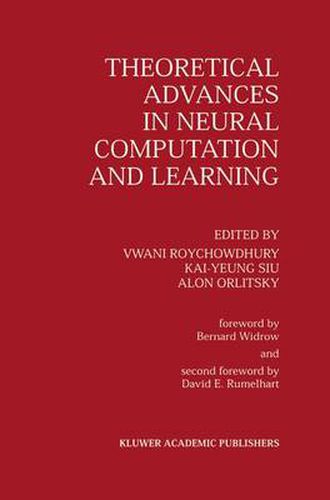
For any research field to have a lasting impact, there must be a firm theoretical foundation. Neural networks research is no exception. Some of the founda tional concepts, established several decades ago, led to the early promise of developing machines exhibiting intelligence. The motivation for studying such machines comes from the fact that the brain is far more efficient in visual processing and speech recognition than existing computers. Undoubtedly, neu robiological systems employ very different computational principles. The study of artificial neural networks aims at understanding these computational prin ciples and applying them in the solutions of engineering problems. Due to the recent advances in both device technology and computational science, we are currently witnessing an explosive growth in the studies of neural networks and their applications. It may take many years before we have a complete understanding about the mechanisms of neural systems. Before this ultimate goal can be achieved, an swers are needed to important fundamental questions such as (a) what can neu ral networks do that traditional computing techniques cannot, (b) how does the complexity of the network for an application relate to the complexity of that problem, and © how much training data are required for the resulting network to learn properly? Everyone working in the field has attempted to answer these questions, but general solutions remain elusive. However, encouraging progress in studying specific neural models has been made by researchers from various disciplines.
$9.00 standard shipping within Australia
FREE standard shipping within Australia for orders over $100.00
Express & International shipping calculated at checkout
Stock availability can be subject to change without notice. We recommend calling the shop or contacting our online team to check availability of low stock items. Please see our Shopping Online page for more details.
This title is printed to order. This book may have been self-published. If so, we cannot guarantee the quality of the content. In the main most books will have gone through the editing process however some may not. We therefore suggest that you be aware of this before ordering this book. If in doubt check either the author or publisher’s details as we are unable to accept any returns unless they are faulty. Please contact us if you have any questions.
For any research field to have a lasting impact, there must be a firm theoretical foundation. Neural networks research is no exception. Some of the founda tional concepts, established several decades ago, led to the early promise of developing machines exhibiting intelligence. The motivation for studying such machines comes from the fact that the brain is far more efficient in visual processing and speech recognition than existing computers. Undoubtedly, neu robiological systems employ very different computational principles. The study of artificial neural networks aims at understanding these computational prin ciples and applying them in the solutions of engineering problems. Due to the recent advances in both device technology and computational science, we are currently witnessing an explosive growth in the studies of neural networks and their applications. It may take many years before we have a complete understanding about the mechanisms of neural systems. Before this ultimate goal can be achieved, an swers are needed to important fundamental questions such as (a) what can neu ral networks do that traditional computing techniques cannot, (b) how does the complexity of the network for an application relate to the complexity of that problem, and © how much training data are required for the resulting network to learn properly? Everyone working in the field has attempted to answer these questions, but general solutions remain elusive. However, encouraging progress in studying specific neural models has been made by researchers from various disciplines.
Search our extensive online catalogue.
