Readings Newsletter
Become a Readings Member to make your shopping experience even easier.
Sign in or sign up for free!
You’re not far away from qualifying for FREE standard shipping within Australia
You’ve qualified for FREE standard shipping within Australia
The cart is loading…


This title is printed to order. This book may have been self-published. If so, we cannot guarantee the quality of the content. In the main most books will have gone through the editing process however some may not. We therefore suggest that you be aware of this before ordering this book. If in doubt check either the author or publisher’s details as we are unable to accept any returns unless they are faulty. Please contact us if you have any questions.
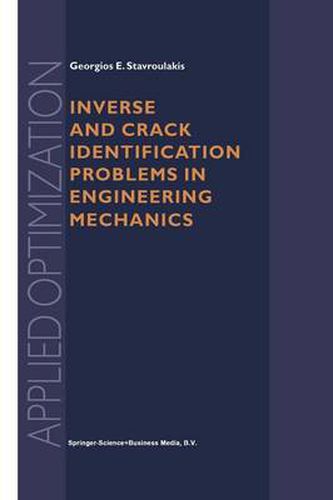
Inverse and crack identification problems are of paramount importance for health monitoring and quality control purposes arising in critical applications in civil, aeronautical, nuclear, and general mechanical engineering. Mathematical modeling and the numerical study of these problems require high competence in computational mechanics and applied optimization. This is the first monograph which provides the reader with all the necessary information. Delicate computational mechanics modeling, including nonsmooth unilateral contact effects, is done using boundary element techniques, which have a certain advantage for the construction of parametrized mechanical models. Both elastostatic and harmonic or transient dynamic problems are considered. The inverse problems are formulated as output error minimization problems and they are theoretically studied as a bilevel optimization problem, also known as a mathematical problem with equilibrium constraints. Beyond classical numerical optimization, soft computing tools (neural networks and genetic algorithms) and filter algorithms are used for the numerical solution.
The book provides all the required material for the mathematical and numerical modeling of crack identification testing procedures in statics and dynamics and includes several thoroughly discussed applications, for example, the impact-echo nondestructive evaluation technique.
Audience: The book will be of interest to structural and mechanical engineers involved in nondestructive testing and quality control projects as well as to research engineers and applied mathematicians who study and solve related inverse problems. People working on applied optimization and soft computing will find interesting problems to apply to their methods and all necessary material to continue research in this field.
$9.00 standard shipping within Australia
FREE standard shipping within Australia for orders over $100.00
Express & International shipping calculated at checkout
Stock availability can be subject to change without notice. We recommend calling the shop or contacting our online team to check availability of low stock items. Please see our Shopping Online page for more details.
This title is printed to order. This book may have been self-published. If so, we cannot guarantee the quality of the content. In the main most books will have gone through the editing process however some may not. We therefore suggest that you be aware of this before ordering this book. If in doubt check either the author or publisher’s details as we are unable to accept any returns unless they are faulty. Please contact us if you have any questions.
Inverse and crack identification problems are of paramount importance for health monitoring and quality control purposes arising in critical applications in civil, aeronautical, nuclear, and general mechanical engineering. Mathematical modeling and the numerical study of these problems require high competence in computational mechanics and applied optimization. This is the first monograph which provides the reader with all the necessary information. Delicate computational mechanics modeling, including nonsmooth unilateral contact effects, is done using boundary element techniques, which have a certain advantage for the construction of parametrized mechanical models. Both elastostatic and harmonic or transient dynamic problems are considered. The inverse problems are formulated as output error minimization problems and they are theoretically studied as a bilevel optimization problem, also known as a mathematical problem with equilibrium constraints. Beyond classical numerical optimization, soft computing tools (neural networks and genetic algorithms) and filter algorithms are used for the numerical solution.
The book provides all the required material for the mathematical and numerical modeling of crack identification testing procedures in statics and dynamics and includes several thoroughly discussed applications, for example, the impact-echo nondestructive evaluation technique.
Audience: The book will be of interest to structural and mechanical engineers involved in nondestructive testing and quality control projects as well as to research engineers and applied mathematicians who study and solve related inverse problems. People working on applied optimization and soft computing will find interesting problems to apply to their methods and all necessary material to continue research in this field.
Search our extensive online catalogue.
