Readings Newsletter
Become a Readings Member to make your shopping experience even easier.
Sign in or sign up for free!
You’re not far away from qualifying for FREE standard shipping within Australia
You’ve qualified for FREE standard shipping within Australia
The cart is loading…


This title is printed to order. This book may have been self-published. If so, we cannot guarantee the quality of the content. In the main most books will have gone through the editing process however some may not. We therefore suggest that you be aware of this before ordering this book. If in doubt check either the author or publisher’s details as we are unable to accept any returns unless they are faulty. Please contact us if you have any questions.
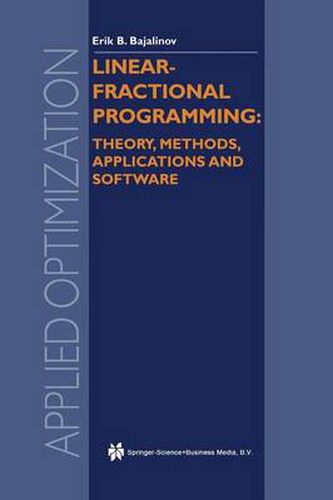
This is a book on Linear-Fractional Programming (here and in what follows we will refer to it as LFP ). The field of LFP, largely developed by Hungarian mathematician B. Martos and his associates in the 1960’s, is concerned with problems of op timization. LFP problems deal with determining the best possible allo cation of available resources to meet certain specifications. In particular, they may deal with situations where a number of resources, such as people, materials, machines, and land, are available and are to be combined to yield several products. In linear-fractional programming, the goal is to determine a per missible allocation of resources that will maximize or minimize some specific showing, such as profit gained per unit of cost, or cost of unit of product produced, etc. Strictly speaking, linear-fractional programming is a special case of the broader field of Mathematical Programming. LFP deals with that class of mathematical programming problems in which the relations among the variables are linear: the con straint relations (i.e. the restrictions) must be in linear form and the function to be optimized (i.e. the objective function) must be a ratio of two linear functions.
$9.00 standard shipping within Australia
FREE standard shipping within Australia for orders over $100.00
Express & International shipping calculated at checkout
Stock availability can be subject to change without notice. We recommend calling the shop or contacting our online team to check availability of low stock items. Please see our Shopping Online page for more details.
This title is printed to order. This book may have been self-published. If so, we cannot guarantee the quality of the content. In the main most books will have gone through the editing process however some may not. We therefore suggest that you be aware of this before ordering this book. If in doubt check either the author or publisher’s details as we are unable to accept any returns unless they are faulty. Please contact us if you have any questions.
This is a book on Linear-Fractional Programming (here and in what follows we will refer to it as LFP ). The field of LFP, largely developed by Hungarian mathematician B. Martos and his associates in the 1960’s, is concerned with problems of op timization. LFP problems deal with determining the best possible allo cation of available resources to meet certain specifications. In particular, they may deal with situations where a number of resources, such as people, materials, machines, and land, are available and are to be combined to yield several products. In linear-fractional programming, the goal is to determine a per missible allocation of resources that will maximize or minimize some specific showing, such as profit gained per unit of cost, or cost of unit of product produced, etc. Strictly speaking, linear-fractional programming is a special case of the broader field of Mathematical Programming. LFP deals with that class of mathematical programming problems in which the relations among the variables are linear: the con straint relations (i.e. the restrictions) must be in linear form and the function to be optimized (i.e. the objective function) must be a ratio of two linear functions.
Search our extensive online catalogue.
